


Viral face swap app Reface is facing a lawsuit over commercial use of celebrity photos.
The Reface app uses artificial intelligence (AI) to create hyper-realistic face swaps. The app, which has over 250 million users worldwide, allows anyone to digitally insert a photo of anyone’s face into video clips of famous people.
It effectively allows users to create deepfake videos with ease and imagine themselves as anything new, from Marvel superheroes to their favorite pop stars.
According to National Law Review, the Reface app has now faced a proposed class action lawsuit from a reality TV performer who alleges the app is commercially exploiting the pictures and likenesses of himself and thousands of other celebrities without their consent.
Kyland Young, a finalist on the show “Big Brother,” filed a lawsuit in April in the U.S. District Court for the Central District of California, alleging that the Reface app violated state public relations rights by showing photos and videos of famous actors, athletes, etc. Musicians whose faces can be swapped out by the app’s users.
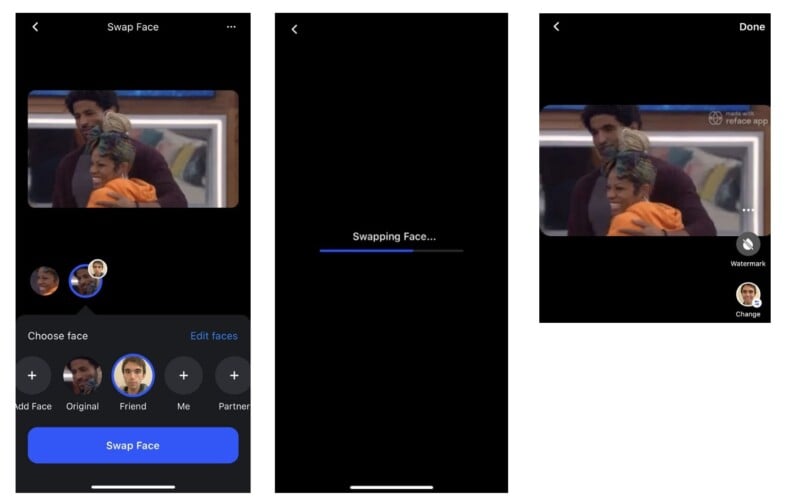
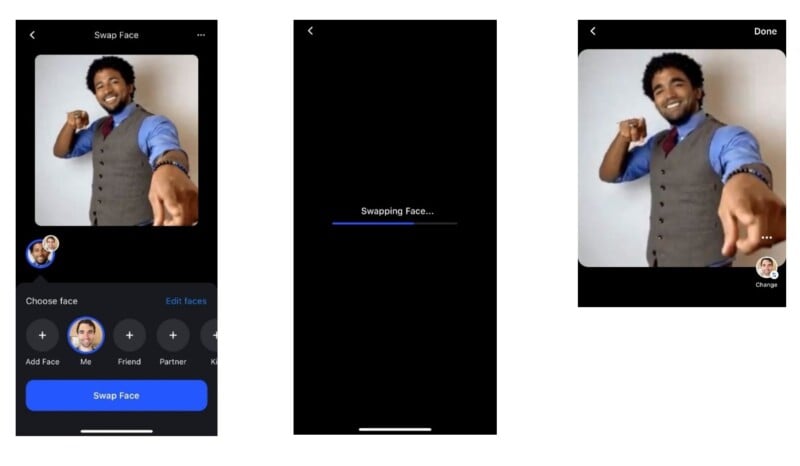 Images in court documents allegedly show Kyland Young’s face being swapped on the Reface app
The complaint alleges violations of the group members’ rights under the California Right of Publicity Statute, which states: “[a]Any person who knowingly uses the name, voice, signature, photograph, or likeness of another person in any way for the purpose of advertising, selling, or soliciting the purchase of services, without that person’s prior consent, shall be liable for all damages , which arise to her person or persons who are injured thereby.”
There are currently no federal laws in the United States protecting against the use of images of celebrities or others without their deepfake technology.
Generative AI transforms intellectual property rights
Young’s lawsuit is among the first cases involving AI-generated images that could imply a wide range of conflicting intellectual property rights. Generative AI makes it possible to use one technology to create large numbers of potentially infringing – but not identical – new images and videos.
In January, a group of artists filed a class action lawsuit against AI image generators Stable Diffusion and Midjourney. They accused the AI image generators of being “a 21st-century collage tool that remixes the copyrighted works of millions of artists whose works were used as training data.”
Meanwhile, in February, Getty Images sued AI image generator Stable Diffusion for up to $1.8 trillion, alleging it stole over 12 million of its copyrighted photos.
Photo credit: Photos via Reface app and court documents.
Comments are closed.