


Archimedes is a state-of-the-art credit and lending market based on decentralized exchanges that:
- Attracts lenders’ capital by offering market sustainable real returns on its liquidity pool
- Allows users to create leveraged positions of up to 10x on high-yielding stablecoins via innovative mechanisms and a great user experience
- Allows partner protocols to attract sustainable long-term capital
As open-source software, Archimedes aims to increase the appeal of DeFi, improve capital efficiency, and create more favorable conditions for institutional and retail investors alike.
Notably, the platform is fully collateralized and designed to provide breakthrough solutions that generate relatively high but realistic returns while mitigating risks such as position liquidation and market volatility. Archimedes innovates how borrowers should buy access to leverage and how issuance should reward lenders, while being designed to reduce user risk by only working with battle-hardened partners and choosing not to start with a liquidation mechanism.
Central to this effort are unique tokenomics designed to attract long-term liquidity and reduce selling pressure on its utility and governance tokens, supporting a robust platform that DeFi delivers differently. Let’s start with a closer look at the two native tokens powering the Archimedes ecosystem.
Why Use Archimedes Finance?
Unlike many other DeFi borrowing and lending protocols, Archimedes Finance takes a qualitative approach to generate benefits for both borrowers and lenders.
Borrower Benefits
- Market top stablecoin APY: Borrowers can access up to 10x leverage to increase returns on interest-bearing stablecoins.
- Relatively low risk: Low risk of liquidation as Archimedes chooses to start with no liquidation mechanism; Archimedes also supports only “Blue Chip”, partners of the highest quality
- Persistent APY: Although the APY on leveraged assets is variable across the market, high leverage helps maintain high returns.
- Automated Set and Forget: With Archimedes there is no need to manage position; No manual compounding or changing positions is required.
- Tradability: Because each position is packaged as an NFT, holders can trade them without unwinding them.
- Plannable innovative fee model: Leveragers or borrowers pay all of their fees up front via Archimedes’ bidding mechanism via auction, meaning there are never variable rate payments to track and the market sets the price of leverage.
Lender Advantage: Real yield and state-of-the-art dynamic issuance
As a liquidity provider, you can earn 1-5% returns on your stablecoins at AAVE or Compound, or you can choose to provide liquidity to non-stablecoin pools at a much higher risk with a high risk of volatile loss.
As many know, liquidity pool APYs are constantly fluctuating based on supply and demand, which is mainly due to CRV issuance rather than real economic activity. As a result, investors often “pool” their capital, reallocating their capital from pools with lower or falling APYs to other available better alternatives. This requires a lot of effort and could pose a relatively large risk when moving to new protocols.
Archimedes wants to help change this narrative by using the so-called “real yield”. This term is defined as the reward given to the lenders as a percentage of the log revenue derived from real economic activity. Done right, Real Yield can help address expensive pool hopping, harvesting, and compounding for investors by avoiding all the hassle and gas fees, all for a lower log fee.
In addition to Real Yield, Archimedes brings a novel solution for governance token issuance to further reward LPs. Archimedes’ issuance aims to avoid over-inflation and varies ARCH issuance size to smooth out ARCH price fluctuations, making APYs sustainable and designed for the long term.
Partner advantage: long-term capital
As a result, Archimedes solutions are designed to allow liquidity providers to remain in a single pool as this is designed to enable sustainable top-of-market APYs. This greatly benefits the pools initiated by Archimedes and his partners and makes TVL more sustainable for both sides.
The Archimedes ecosystem
Archimedes protocol issues lvUSD tokens. This over-collateralized USD-pegged stablecoin is backed by interest-bearing tokens and is the “oil” of its leverage engine.
Alongside the lvUSD stablecoin is Archimedes’ governance and utility token: ARCH.
ARCH plays an important role in the Archimedes ecosystem and will facilitate access to leverage.
Let’s take a closer look at how these tokens power the Archimedes Protocol.
How to use Arch to create leverage
In Archimedes, borrowing means building a leveraged position, which is the action of borrowing funds to increase the size of a position, and therefore the rate of return. Like many decentralized lending protocols, Archimedes requires collateral for lending. Unlike other platforms, however, Archimedes doesn’t currently have a liquidation mechanism – instead, it works like this:
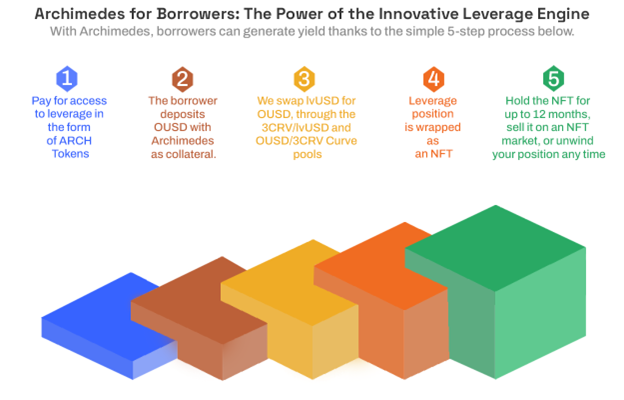
Step 1: Bid with ARCH to access leverage
First, the user must buy access to leverage through Archimedes’ bidding mechanism. Leverage costs are measured by how many ARCH tokens buy the equivalent of $1 in leverage, but this relationship depends on how much the market is willing to pay for Archimedes’ leverage. With this leverage bidding mechanism, the Archimedes team will announce each time a leverage round is available. The protocol defines an initial leverage price that decreases over time until a floor price is reached or the full leverage is used, whichever comes first. So, since leverage is scarce, users who wait too long may miss the opportunity.
When borrowers buy leverage, they are actually borrowing appreciation OUSD stablecoins from curve pools via Archimedes. When OUSD rates rise, borrowers can generate a higher APY position. This means that users bid in the auction based on what they think OUSD earnings will be worth in the future.
These ARCH tokens are then used to compensate lenders, Archimedes curve liquidity providers (LPs). As a result, the APY for these lenders will be affected by how many borrowers are using their position and the cost of leverage.
This idea is super innovative and revolutionary – we love what Archimedes builds.
Step 2: Provide collateral
In addition to ARCH, borrowers are also required to post collateral in the form of Origin Dollar Tokens (OUSD). For example, with $10,000 worth of OUSD as collateral, investors can borrow up to $90,000 for 10x leverage.
Step 3: Create a position
By creating a leveraged position, borrowers hope to earn up to a 10x return (or a whopping 50% APY in current market conditions) on interest-bearing stablecoins. Behind the scenes, the Archimedes protocol handles the creation of each position and represents each as an NFT.
Step 4: Relax, Sell or Renew
Any accrued interest will be “saved” under this NFT, meaning that each unwound position will generate the original principal amount plus any profits derived from interest. And since each leverage position is packaged as an NFT, holders can trade them without liquidating the position.
These NFTs also serve as entry points into the DeFi ecosystem for those interested in novel digital assets, or for traditional centralized finance (CeFi) users looking to benefit from revenue-generating utility tokens and the transparency of DeFi.
This allows position holders to choose to liquidate the NFT, sell or withdraw their proceeds after around 12 months when the position expires, or renew the position if and when more leverage is available.
We strongly believe in the product as it solves one of the biggest pain points for protocols in DeFI: securing long-term TVL. “Curve wars” or bribery over votes have low ROI for protocols striving for liquidity, and governance token issuance is mostly unsustainable. Thus, Archimedes can help affiliate protocols maintain liquidity for relatively long periods of time, and these affiliates would be willing to pay big for it.
This is how lending works
The Archimedes Protocol was designed for lenders looking for stable, relatively low-risk returns. As mentioned, those who provide liquidity to Archimedes’ 3CRV/lvUSD pool lend it to borrowers, supporting leveraged stablecoin positions. Borrowers or leveragers borrow funds for a limited period of time and pay all interest up front in ARCH tokens. A performance fee is charged in addition to each leveraged position. Together, these fees and state-of-the-art dynamic ARCH issuance determine the APY for lenders.
What Archimedes is doing for DeFi
As a state-of-the-art unforked protocol, Archimedes breaks with the DeFi status quo by adding a leverage option with no liquidation mechanisms, offering up to 10x leverage and bringing a novel and unprecedented utility to its governance token that rewards lenders will be Real Yield and a state-of-the-art dynamic issuance design, as well as integrating the use of interest-bearing stablecoins. These capabilities allow Archimedes to provide a solution that addresses the sustainability issue in liquidity pools, which typically start with high returns and quickly dry up over time.
By backing only a few proven projects and applying its innovative mechanisms and designs, Archimedes positions itself to succeed in any market scenario, bullish or bearish. Its mechanism is built to think of the long-term relationship with liquidity providers and partners while allowing access to scale.
In addition, Archimedes builds his solutions for everyone. Its user interface and experience are designed to encourage adoption for DeFi and non-DeFi users alike.
Despite the product’s innovative twist, it’s important to note that Archimedes is an experimental protocol that carries significant smart contract risk, economic model risk, and asset risk. Additionally, DeFi borrowing and originating is often complex, which means users should remain diligent when making investment decisions.
While there are significant risks to consider, it’s worth noting that CeFi platforms have struggled the most amid recent market volatility. This reality suggests that DeFi protocols like Archimedes are operating as transparently as they should and are poised to perform even better as they mature.
The project will start soon and you can visit the website at https://archimedesfi.com/ to know more about the product.
Learn Crypto Trading, Yield Farms, Income strategies and more at CrytoAnswers
https://nov.link/cryptoanswers
Comments are closed.