


The demand for efficient money markets is so great that the inflation rate of 8.5% does not diminish it. That’s how much the dollar has lost in purchasing power compared to last year. However, stablecoins are pegged to the dollar regularly have the highest interest incomeenough to outpace inflation.
Why would tokenized dollars generate such prime returns? Although crypto traders love volatility as it allows for higher profits, cryptocurrency volatility is not conducive to serious DeFi infrastructure. Stablecoins introduce this seriousness stabilitybased on the dollar’s global reserve currency status.
Stablecoins not only provide stable value to use in payments, but also remove the risk of smart contract lending. Because of this, DeFi protocols are typically backed by volatile cryptocurrencies to host stablecoin loans.
Source: International Monetary Fund (IMF)
In addition, the volatile assets used as collateral are usually over-collateralised. In this way, when the value falls below a certain liquidation ratio, the lender can rest assured that the smart contract will automatically liquidate the collateral. Case in point: During the first quarter of 2022, the Compound protocol saw a huge spike in collateral liquidations due to ETH volatility.
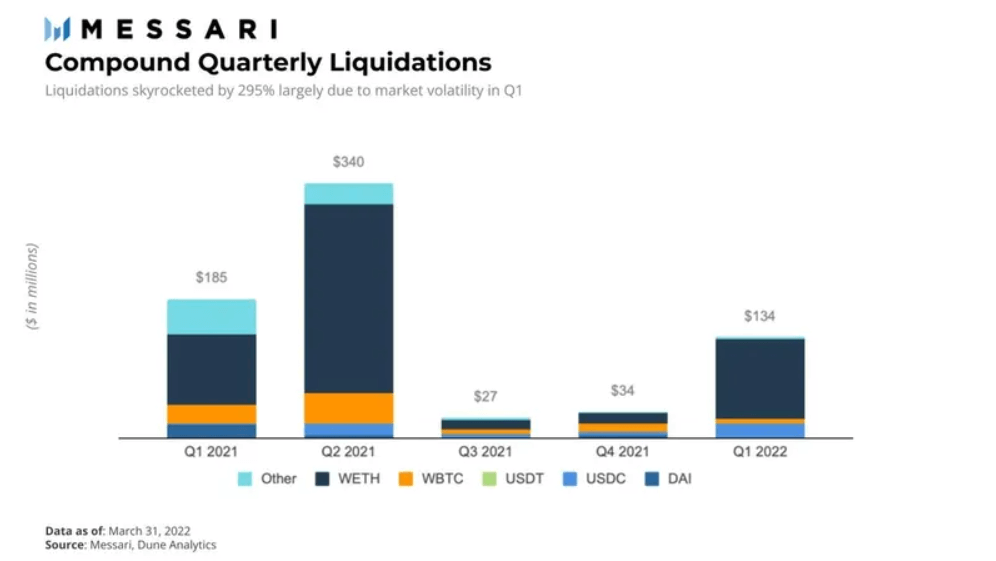
Although crypto assets need to be over-collateralized to offset volatility, what about stablecoins? Is their collateral stable enough to inspire investor confidence?
New generation of stablecoins on the horizon
One might think that DeFi protocols would rely on stablecoins, which are also decentralized. That hasn’t been the case for most of the stablecoin growth over the past two years, currently at $186.8 billion. The two main off-chain stablecoins, Tether (USDT) and USD Coin (USDC), are typically collateralized and backed by reserves of cash or cash equivalent.
This simplicity has kept Tether the best stablecoin in terms of both market capitalization and trading volume– since its launch in 2015. Despite some Ambiguity behind Tether’s reservesit’s had growing traction for years, like USDT remains easily accessible.
The first to break through this form of centralization was DAI from the MakerDAO platform on Ethereum. This algorithmic stablecoin is now backed by half a dozen cryptocurrencies from initial ETH collateral alone. Unfortunately, because it is an Ethereum ERC-20 token, it is vulnerable to Ethereum’s high transaction fees.
While Ethereum is still the DeFi backbone with a 53% (95.5 billion) market share, no one can argue that it is suitable for cheap and fast stablecoin transfers. In contrast, the stablecoin TerraUSD (UST) is showing itself to be a game changer on the rival Terra blockchain. Using the Cosmos framework, Terra (LUNA) Blockchain was developed as a global payment system offering up to 10,000 tps for a negligible flat fee.
TerraUSD: Ushering in the new era of L1 stablecoins
Virtually a blockchain on par with Visa in performance, Terra enriched this faster backbone with a UST algorithmic stablecoin. It was a Huge success. In a single year, UST increased its market cap by 890%, from $1.86 billion in April 2021 to $18.42 billion in April 2022. UST not only became the third-largest stablecoin, but also Terra’s anchor protocol for yield Farming gained the upper hand over dominant Ethereum-based DeFi lending protocols.
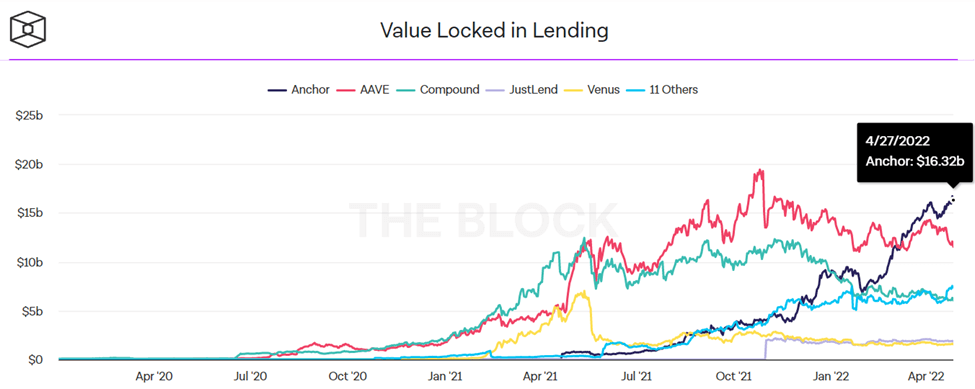
Terra’s Anchor has outgrown both Aave and Compound, the DeFi pioneers in smart contracting and lending. Terra’s appeal clearly stems from Anchor’s popularity, as 67% of UST demand comes from the protocol.
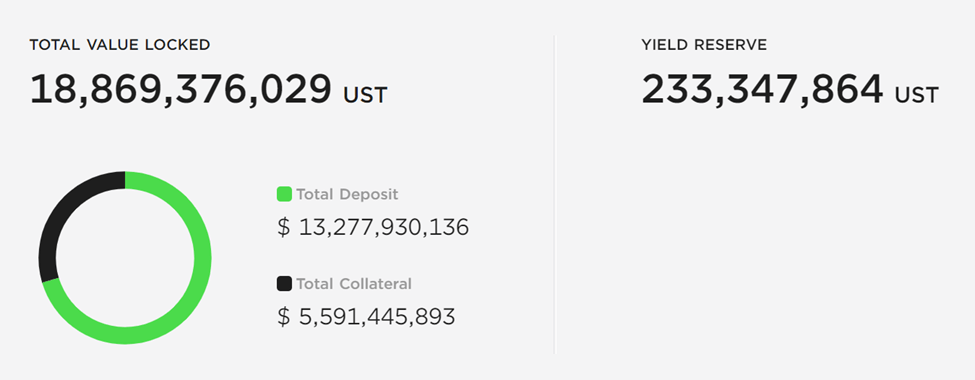 TerraUSD (UST) stablecoin structure. Source: AnchorProtocol.com
The anchor protocol, in turn, draws its strength from the way Terra’s UST stablecoin is collateralized. As an algorithmic stablecoin, UST maintains its peg dynamically withdraw either LUNA or UST from circulationin a process commonly referred to as Combustion.
In this process, UST tokens are needed to mint LUNA tokens, Terra’s native cryptocurrency, just like ETH for Ethereum. Conversely, LUNA tokens are required to mint UST stablecoins. Either way, the supply of UST/LUNA will either increase or decrease, maintaining UST’s peg to the dollar.
Because of this elastic supply, traders have an opportunity to profit from arbitrage. For example, if UST falls to $0.97, traders can buy it at that lower price and sell UST for LUNA. This decreases the UST supply, making it tighter, causing its price to rise closer to the 1:1 dollar peg.
This algorithmic pegging ties directly to Anchor’s massive APY 19.49% at the time of going to press.
How does Anchor maintain a yield of up to 20%?
So far, Anchor has been quite successful in the money markets. By escrowing UST tokens, investors can access an APY of up to 20%. In this way, they become lenders that provide the anchor protocol with its liquidity for borrowers.
In return, borrowers must provide collateral for the loan. Currently, Anchor uses bETH and bLUNA as securitized collateral. Of course, these are also overcollateralised. The trick is that staking rewards on either bLUNA or bETH are liquidated in UST using its liquid staking protocol.
“bAsset tokens are an entitlement to the underlying staked asset position, where staking rewards are distributed to their holders.”
-Anchor log White paper.
With a 12% LUNA staking return and a high credit limit, the two-digit anchor APY then becomes a predictable outcome. In fact, this mechanic is similar to the repledgea financial process in which the same collateral is reused as collateral for another loan.
Other L1 chains are following in UST’s footsteps
Terra isn’t the only Layer 1 blockchain directly competing with Ethereum’s DeFi ecosystem. Just as Axie Infinity unleashed an avalanche of blockchain games culminating in the ApeCoin metaverse token, the success of UST inspired two competing networks to launch their own algorithmic stablecoins.
USDD stablecoin from TRON
The Tron network, specifically TRON DAO, announced the release of its own USDD algorithmic stablecoin. In his Blog Announcement, Justin Sun, the founder of Tron, is positioning the new stablecoin as a generational shift in technology. Similar to Terra, the Tron network specializes in stablecoin payments, processing over $4 trillion in USDT transactions.
USDD represents the third generation of stablecoins as they are fully on-chain with no centralized institutions. The new stablecoins are close to a May 5 release and will also be available on Ethereum and BNB Chain.
“USDD decentralized stablecoin will free holders from arbitrary central authority regulations and remove all barriers to entry. Unlike centralized institutions that can freeze or confiscate user funds at will, decentralized stablecoins effectively protect private property rights.”
USN stablecoin from NEAR
Another Ethereum competitor is the NEAR protocol with the Nightshade scaling solution and the Doomslug proof-of-stake consensus protocol. While Ethereum has yet to be sharded next year, the NEAR blockchain launched back in 2020 with built-in sharding chains. In NEAR’s iteration of sharding technology, not only are transactions processed in parallel across multiple sharding chains, but each shard generates “chunks” of blocks that need to be completed.
Meanwhile, NEAR’s Doomslug consensus removes block competition from the consensus. As a result, transaction finality can be delivered within seconds, resulting in a total network throughput of up to 100,000 tps. The transaction fees are also negligible as a result. On this Formula 1 of Smart Contracts, NEAR only recently started its own USN stablecoin.
USN mirrors Terra’s UST and has no cash reserves, relying on NEAR tokens for collateral, which will be boosted with USDT in the initial phase. Decentralized bank DAO will manage its reserve fund in partnership with Proximity Labs. And just like UST, USN will generate revenue based on NEAR token staking rewards.
Accordingly, the minimum return should be 11% APY, possibly up to 20% for first-time lenders. according to decentralized bank.
Is the 3rd generation stablecoin really worth it?
At first glance, algorithmic stablecoins are a natural fit for the DeFi ecosystem as they are the final cog fully in the chain, with the help of oracles feeding it fiat data. While this pushes the decentralization aspect to its limits, do algorithmic stablecoins create more vulnerabilities?
From what we’ve seen them working with Terra’s UST, there are a few vulnerabilities that come from multiple sources.
The first is the need to sustain constant demand, including the network’s native cryptocurrency. Without them, the level of support is dwindling, which is why Terra’s co-founder, Do Kwon, has announced another step up Strengthen UST with $10 billion worth of bitcoin. However, this also depends on the long-term prospect of Bitcoin rising.
“I bet the long-term scenario of bitcoin rising and reserves being strong enough to withstand a drop in UST demand is the more likely scenario.”
– Terraform Labs CEO Do Kwon on Unchained Podcast.
The second vulnerability arises from decentralization itself, which relies on the market to regulate itself. Therefore, algorithmic stablecoins rely on a bullish view of the market in both scenarios. That European Central Bank formulated it as “based purely on the expectation of its future market value”.
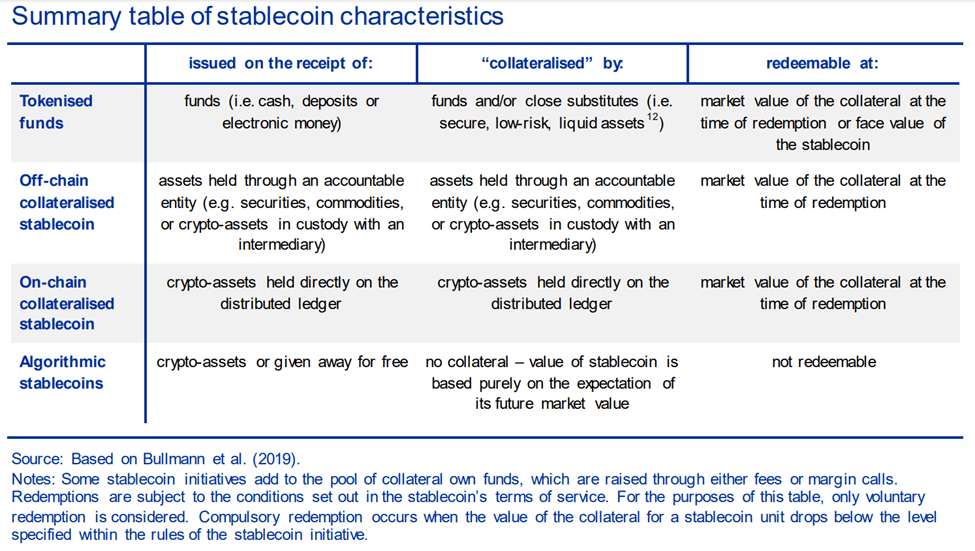
Ultimately, one could say that they are inherently fragile because they rely on a multi-layered incentive structure to maintain certain ground levels. In a market stress test some fared better than others.
On the other hand, one of the more glaring stablecoin algorithmic failures occurred, as one would expect. In the case of Iron Finance with its IRON stablecoin, it has not grown with market demand. One has to ask, then, is the introduced complexity with automated smart contracts, market arbitrage, and reserve token protocols too high a price to pay for decentralization?
Only time can tell. Without a doubt, DeFi offers benefits that our legacy financial system cannot even dream of. But – we will still have to work out a few kinks for a while.
Guest post by Shane Neagle from The Tokenist
Shane has been an active supporter of the movement towards decentralized finance since 2015. He has written hundreds of articles on developments around digital securities – the integration of traditional financial securities and distributed ledger technology (DLT). He remains fascinated by the growing impact of technology on business – and daily life.
Learn more → 
Get one edge on the crypto market 👇
Join CryptoSlate Edge and access our exclusive Discord community, more exclusive content and analysis.
On-Chain Analysis
Price Snapshots
More context
Sign up now for $19/month. Discover all the advantages
Learn Crypto Trading, Yield Farms, Income strategies and more at CrytoAnswers
https://nov.link/cryptoanswers
Comments are closed.