
AlpacaFinance on Binance Feed: Product Update: Next Generation Leveraged Yield Farming


dear alpacas,
As decentralized exchanges (DEXs) upgrade their automated market-making logic to incorporate concentrated liquidity (CL) and shift their incentives and rewards to this new model, so must yield-generating protocols built on top of DEXs, such as Alpaca Finance are evolving to continue offering high-margin products to their users.
In this article, we share with the herd our thought process, various options we’ve considered, the path we’re currently taking, and the progress and anticipated timeline for the new Leveraged Yield Farming (LYF) product to be launched in CL DEXs will be integrated.
Background:
First, let’s quickly go through some basics to gain practical knowledge of how the CL DEX model works.
In short, the CL model allows liquidity to be allocated within a user-selected custom price range. In the previous version of the XYK DEX, liquidity was evenly distributed across all possible price ranges (zero to infinity). By concentrating their capital on smaller price intervals, Liquidity Providers (LPs) can earn more fees when there is higher trading volume in the selected range. At the same time, traders also see higher liquidity around the current price, resulting in lower price impact costs.
However, there is no free lunch. These advantages come with more complex position management and a higher IL for LPs. We will discuss these issues in more detail related to different ways of integrating with CL DEXs in the following sections.
🌌The different ways to integrate with CL DEXs
In this section, we’ll walk you through the different approaches we could take when integrating with a CL DEX, as well as our analysis of each method, culminating in the final approach we’ve decided on.
1️⃣ Option1: Customizable custom LYF position
One approach would be to integrate with a CL DEX in a way that allows users to customize and open their own custom LYF positions. Users would have the freedom to choose the price range, leverage, pool to operate, and assets to borrow. While this setup may be similar to the current “Farm” feature in AF1.0, there are key fundamental differences and challenges:
Challenge #1: Active position management
The provision of liquidity in the UniswapV2 DEX is a passive set-and-forget endeavor. Your assets are always active and generating income. While executing a LYF one would need to monitor price movements to protect a position from liquidation, but if the leverage level chosen were conservative, i.e. ~2x, the likelihood of liquidation would be greatly reduced and the monitoring required would be limited to only when it closed a big price movement came.
With a CL DEX, LPs often need to reset/adjust the range when price moves outside of the initially selected range in order to continue earning returns. In addition, the price range would need to be very tight to achieve the advertised APR % for some pairs, which then requires active management and frequent range adjustments.
We believe that the complexity and level of attention required will make this product unpopular with retail users and difficult to keep profitable as range adjustment of positions in LYF involves carry swap costs .
Challenge #2: Gasoline Costs
Ownership of the CL DEX LP position is represented as an NFT instead of a fungible token – i.e. ERC20. This means individual positions cannot be aggregated into a single vault to benefit from more gas efficient position management. Specifically, each position’s income from liquidity mining and trading fees must be reinvested individually and separately. Regardless of whether the transactions were activated by a user or the protocol, it is clear that the sending costs for this setup would increase greatly, affecting profitability, especially for smaller positions. (For reference, AF1.0 has thousands of active positions.) Finally, we observed this integration in production for over a year in another protocol with limited acceptance, further suggesting that this product may not be fit for the market . For all of the above reasons, we don’t think this is the optimal direction.
2️⃣ Option 2: Simple position manager
Another approach would be to create a simple location manager that aggregates users’ locations into vaults, reducing the administrative burden on users. The manager would handle basic functions such as readjusting the price range to ensure the LP is always active and reinvesting liquidity reduction premiums and trading fees, among others.
The hallmark of this approach is a relatively simple and deterministic set of rules for managing the vaults. At the same time, managers will not necessarily provide backtesting results, actual historical performance, or promise strategy profitability.
Challenge #1: Fleeting Loss
Many of our readers are familiar with the concept of impermanent loss (IL) as we have discussed it extensively many times. If you are new to this topic, please read our docs. With a CL DEX, the temporary loss is greatly magnified by the tighter liquidity range. If the position is not managed properly, all profits from fees and liquidity mining rewards will be offset by IL.
We see many protocols working on this solution and there are several live products that have been around for a while. However, based on our research, we have yet to see a company that we can convincingly believe will bring positive long-term returns to users.
For one, while many of these logs do show various stats like current APY, fees earned, historical TVL, etc., the only key piece of information that is glaringly missing is the stock price of the historical vault or the actual yield of the vault. We have not yet seen a protocol in this sector that has transparently published the historical return of its position manager, as we have done with our automated vaults.
Alpaca Finance transparently publishes historical returns for all of its AVs
Additionally, we’ve seen from our own experience with AV-v1 how difficult it is to defeat IL. With our relatively simple rebalancing rule, it worked in a high-return environment, but quickly became unprofitable in a low-return, high-volatility market. We have no reason to believe that this approach would generate a positive return in a CL DEX where IL is enlarged.
Given the simpler logic of vault management option #2, it would require less R&D effort, allowing us to get to market faster. However, we anticipate that it will not bring positive returns to users in the long term and therefore the product would not be sustainable.
3️⃣ Option 3: AV v3
What we believe is required to create a successful and sustainable product is an AV-v3. The third iteration of our Automated Vault would build on the experience and proven success of AV-v2. However, given the differences between CL DEX and UNIv2 DEX, we need to rethink some design aspects from the ground up. However, we think this is a good thing as we now have a lot more design freedom to make AV more sophisticated and versatile, ultimately resulting in higher returns for users.
Some of the key questions our R&D team is working to answer are:
-
What is the optimal price range for LP under different market conditions?
-
What are the benefits of having multiple LP positions (different areas) in an AV?
-
Given CL’s increased capital efficiency, what is the optimal leverage?
-
How can we carry out the buyback more efficiently as part of the CL model?
-
What is the best way to make vault deposits and withdrawals with minimal cost to users and minimal impact on current vault exposure?
-
How to automate this product so that users don’t have to do administrative tasks?
…In the next section we will discuss the current progress and timeline for AV-v3.
📆 progress and timeline
Now that AF2.0 MM is live, AV-v3 production is our top priority on the product side. We can imagine that the development of AV-v3 consists of two main parts: 1) the smart contract to manage the positions and 2) the logic to manage the positions profitably.
To add context, here are some of the elements we will create to manage the AV positions.
-
Composition/leaving the LP position
-
Reinvest trading fees and liquidity mining rewards
-
Staking/staking LP tokens for liquidity mining rewards
-
Logic/algorithm to allow users to conveniently turn on/off AVs
-
Set/adjust LP range, repurchase/realign
-
Borrowing and debt repayment integration with AF2.0 MM…
-
At the same time, we also conduct back tests and simulations of various logics to find the most effective way of operating AVs under the CL DEX.
To speed up the development process, we have hired additional researchers/developers to work on these tasks. As AV-v2 shows, it is all about finding the right strategy and being profitable in the long term. Once we have that, the rollout and TVL can be very quick given Alpaca Finance’s track record of security and professionalism.
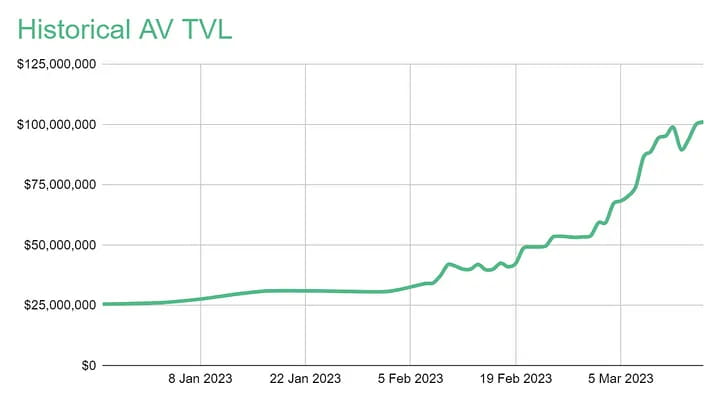 AV-v2’s TVL increased fourfold to $100M in less than two months
According to our current estimate, AVv3 should be ready Early in the third quarter of 2023, around July.
We will share more details on the development and launch schedule shortly before the launch date.
We believe our experience and track record of operating automated vaults for over 12 months makes us unmatched in the industry for the knowledge, skills and expertise to develop a profitable automated vault. We also hope that the past two years have shown our community the work ethic and dedication of our team to developing and delivering great products. We strongly believe that this product offers potential benefits. AV-v3 will have a greater competitive advantage in the era of CL Dexs as it may be one of the few profitable passive yield farming strategies out there. Existing yield aggregators and simple strategy vaults also need to evolve or they will no longer be profitable. Becoming a leader in this category will open up many future growth opportunities for Alpaca Finance, including cross-chain expansion to offer this product to other chains with a strong CL DEX presence.
Thank you for taking the time to read this article and for your support. Please follow us on our social media channels to stay up to date on future developments!
#yield farming
#pancakeswapv3
#DEX
#RealYield
#BNB
Learn Crypto Trading, Yield Farms, Income strategies and more at CrytoAnswers
https://nov.link/cryptoanswers
Comments are closed.