


3 Uniswap
Uniswap is a decentralized AMM exchange for ERC-20 tokens (now also works on other EVM chains like Polygon, Arbitrum or Optimism) and supports ETH and ERC-20 contracts in a 1:1 ratio.
The main advantage is the flexibility of the token launch, which means that anyone can launch the token on Uniswap without any additional fees.
Uniswap now has over $4.7B in TVL.
Uniswap V2 vs. Uniswap V3 liquidity pools
Over the past 2 years, the most widely used DeFi protocol (Uniswap) has been improving its liquidity pools model (trying to find the product market-ready).
First, the V2 model was launched in 2020, ushering in the era of decentralized finance.
V2 was about creating liquidity pools for all ERC 20 tokens (especially the tokens that are not available on other crypto exchanges).
A year later, in May 2021, the V3 model was launched. V3 offered much better capital efficiency than V2, meaning liquidity can be more concentrated and also used efficiently for stablecoin trading where liquidity concentrated on a specific price range is a key feature.
After 2 years, it turned out that V3 completely dominated trade value in USD, while V2 was the leader in terms of transaction volume metric.
4 balancers
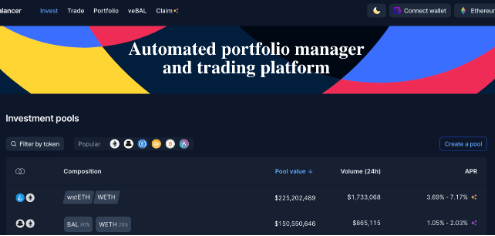
Balancer is a decentralized crypto liquidity pool that also serves as a price sensor and non-custodial portfolio manager.
The main benefit here is the ability to create multiple pooling options, meaning you can create pools of more than two digital assets in a single pool.
What is interesting is that users can create different types of pools (private, public and smart).
Balancer is also called heaven for DeFi farmers because every pool for every token can be found there and the APR is also higher than on competing platforms.
The whole idea of the protocol is to provide an automated market maker solution running on the pools provided by the users.
Balancer was founded in 2018 and its TVL has grown to over $1.6 billion.
5 Bankor
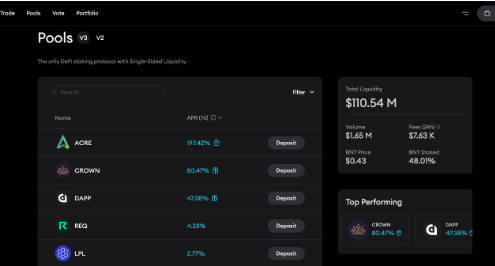
Bancor is one of the OG Ethereum-based DeFi platforms that uses an algorithmic market-making formula to leverage pooled liquidity.
Bancor Relay’s liquidity pools address liquidity volatility concerns.
It is similar to Uniswap or Balancer but focuses on low-cap tokens that are not listed on exchanges. Sometimes there is a situation where the transaction costs can be unreasonable, and this is where Bancor’s main advantage comes into play.
They use a technology solution called “Smart Token” that allows crypto traders to buy and sell low-cap tokens with fractional fees.
The main disadvantage, cited by the “Bitcoinchaser” blogger, is Bancor’s low liquidity in a bank run (a massive sell-off) situation, when reserves could potentially be depleted after a 20% price move.
Bancor’s TVL is floating around $115 million.
6 curve financing
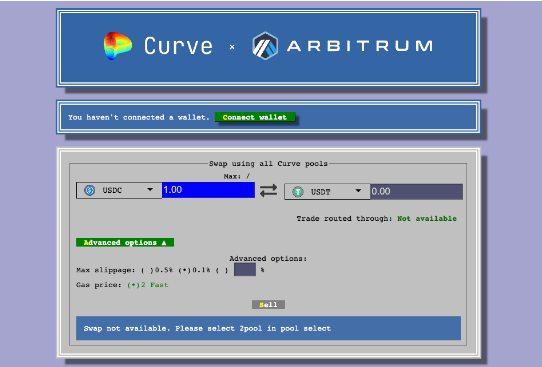
Curve Finance is one of the protocols born on the DeFi summer, best known for its innovative “ve” tokenomics and protocols built on top of Curve.
Not only that, but it is also an Ethereum-based (and stretched to other chains) decentralized crypto liquidity pool designed for trading low-slip performance stablecoins.
The reduced slip is the main benefit here. Curve offers pools for the 7 most popular stablecoins on different EVM networks, allowing traders to transact stablecoins (including DAI, USDT, USDC, BUSD or TUSD) on Ethereum, Arbitrum, Polygon or Optimism.
The pools provide a mechanism whereby users can exchange large amounts of stablecoins without affecting the stablecoin’s dollar peg and without having to find the counterparty to the transaction, as the exchange mechanism runs on liquidity pools stimulated by the $CRV token .
Curve’s current TVL is now around $6.3 billion, making Curve one of the largest DeFi protocols ever.
Learn Crypto Trading, Yield Farms, Income strategies and more at CrytoAnswers
https://nov.link/cryptoanswers
Comments are closed.