


NiseriN
Summary of the thesis
Bitcoin (BTC-USD) is an ideal investment to hold, in my opinion, no matter what the Federal Reserve does. In this article, I talk about the different directions the Fed can take, what the consequences would be for the economy, and what would happen to the price and value of bitcoin.
Ultimately, I believe no matter what the Fed does, Bitcoin will thrive. Loose monetary policy will inflate assets, which is good for Bitcoin. On the other hand, further monetary tightening, although bad at first, would eventually lead to a complete economic collapse, causing a run on the dollar, leaving Bitcoin as one of the few assets capable of storing value.
The current state of affairs
Monetary policy has been used as an economic tool for thousands of years. The economy was “boosted” in Roman times by making more coins from less pure metals. During World War II, the Federal Reserve helped the Treasury Department by capping interest rates, and before that various attempts were made to encourage growth through deliberate currency devaluation.
Today, economists believe they have perfected the art of monetary policy, and indeed it seems the entire market is hanging on the words of Fed officials.
While the Federal Reserve has managed to maintain some semblance of normalcy since the gold standard was delisted in 1971, it has built an incredibly fragile and ever-expanding house of cards, by which I mean debt with only one real way out; A severe credit crunch, a long recession and a much less dollar-dependent global economy.
Since the collapse of the dot-com bubble, or perhaps even before, the Federal Reserve has paved the way for this outcome. Every crisis, dot-com, real estate, and more recently COVID, is met with the same response, with more fiscal and monetary stimulus. In other words, cover the problem with a mountain of debt. Debt has indeed become systemic, so there is no way to “normalize” politics without major upheaval.
Fed’s Catch-22
The Federal Reserve is in a Catch 22 situation because it cannot normalize policy without destroying the economy, but non-normalization will eventually destroy the economy. There are at least 3 reasons why the US cannot return to normal monetary policy any time soon:
-
debt markets
-
national debt
-
recession
For starters, businesses and households in America depend on cheap debt,

Private Debt to GDP (Trade Economics)
The chart above shows the debt-to-GDP ratio, which has increased by over 50% since 1995. This becomes an even bigger problem as growth slows and debt continues to mount due to interest payments.
The same applies to the federal budget:
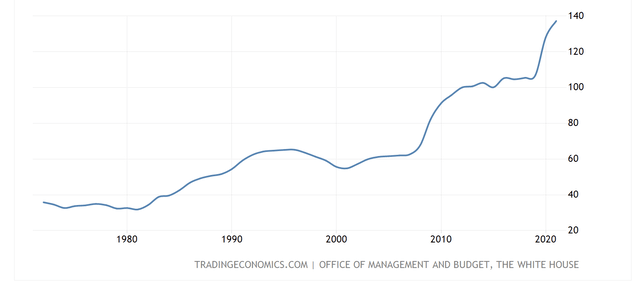
Public debt/GDP (trade economy)
We now have almost 140% of debt to GDP. This graph isn’t just growing, it’s growing exponentially, and it can’t go anywhere else. Every year the population is aging and social security costs are increasing. More debt is the only way to maintain the current status quo.
Which brings me to my third point, which is that a significant change in policy, ie normalization, would completely disrupt society and likely lead to political turmoil, which the Fed is keen to avoid at all costs.
Two possible outcomes
There are two ways this can go.
First of all, the Fed could take the pill, hike rates and stop QE forever. What would happen in this scenario? Mortgage rates would be much higher, which would drain the housing market. This would have a real impact on consumer spending, which would hit businesses. These companies would be forced to simultaneously reduce their activity and their debt. Without the possibility of refinancing their lines of credit, which have hardly any higher interest rates, many would no longer be able to continue working. To cope with these higher rates, the deficit would need to be sharply reduced, which would further dampen economic activity.
Eventually the economy would suffer a 1930s-type depression caused by a major credit crunch. Most likely, at some point in this cycle, the Fed would try again to improve the situation by re-inflating the bubble. However, the only thing that would inflate away is the value of the currency. The US could and probably would monetize Treasuries, but the rest of the economy, deep in a full-blown deleveraging cycle, would not respond to the stimulus. The private sector would refuse to incur more debt, and only when the dust settles and the system is cleansed of the excesses of the past few decades could the US return to some semblance of normalcy.
We’re getting a taste of it now, but I don’t think the Fed will allow a full-blown implosion. The more likely scenario is that the Fed will at least try to keep the musical chairs game going. The Fed will tighten for a while but will eventually have to return to QE and 0% interest rates as the economy falters and debt/GDP levels threaten to become unsustainable.
Well, the Fed can probably get away with it for some time, and it already is, because the rest of the world is caught in the same trap. Despite unprecedented quantitative easing, the US dollar continues to be held as the world’s reserve currency and is paradoxically stronger than ever, at least relative to other currencies.
So as long as we all agree we can blow our debt away forever, but history shows that eventually something will move the needle enough to cause a shift. A shift that would likely propel us back to scenario one.
How will Bitcoin perform?
In the first scenario, bitcoin would serve as a means for the wealthy to preserve their wealth and protect themselves from exposure to the dollar, which by this point would likely be on the brink of collapse. The USD has managed to hold its value as it is the world’s reserve currency and is backed by the world’s most prosperous economy.
However, with the US economy in disarray, it is only natural to assume that this would cast a shadow of doubt on the US dollar given the possibility of some sort of Treasury default. It is likely that foreign countries would sell government bonds en masse, causing a run on the dollar and replacing it with a different standard of value.
As an American, holding bitcoin would be one of the most convenient ways to preserve global purchasing power. In fact, a US dollar collapse could put solid monetary alternatives like bitcoin and gold back on top of the global economic system.
In scenario number 2, where the Fed keeps printing money endlessly, or at least tries to, Bitcoin would also do very well. The ongoing oversupply of dollars would cause the currency to steadily depreciate. This could go on for decades, with assets steadily appreciating while purchasing power wanes. Instead of deflating the debt, we would inflate it away.
But as inflation becomes a constant concern, people would quickly start turning to alternative investments, which would exacerbate inflation even further. Once systems were in place to replace the dollar, the world would turn its back on US currency, likely in favor of a commodity-backed currency.
The US government could try to defend USD value, but that would inevitably lead to Scenario 1, where the US economy goes into a deflationary credit crunch.
Either way, we would find ourselves in a situation where the US dollar would eventually lose its value and its place in world domination. Once again, Bitcoin and other finite resources like gold, land, and oil would be the best place to invest in this case.
Bitcoin: A New Beginning
The great thing about Bitcoin is that it can act as a “risk” type asset while the current debt bubble lasts, but once it bursts it becomes even more valuable due to its use as an alternative currency and store of value.
That may seem far-fetched at the moment, but there is clear evidence of Bitcoin’s value all around us. Bitcoin is used in many places where currency and political stability are not guaranteed, like Africa.
Even more, if we get a system-wide outage that many have been talking about for years, Bitcoin will become not just a store of value, but potentially the most helpful tool we could have to help rebuild our financial system.
Bitcoin already has its own financial system that is largely sealed off from external shocks. Onboarding is easy, anyone can join the Bitcoin network and the system is self-regulating. That is the magic of decentralized systems.
Bitcoin and the DeFi ecosystem built around it and other cryptocurrencies could become the lifeboat the world needs in its darkest hour.
Bring away
In summary, no matter what the Fed does, Bitcoin is a must. In the best-case scenario, we’ll keep the music going for them for the next 100 years. During this time, however, the dollar would suffer a sharp fall in value while bitcoin would continue to appreciate due to its limited supply and increasing use as a store of value.
However, sooner rather than later we could see a major credit crunch and a sharp depreciation of the USD. At this point, those who don’t own Bitcoin will realize why owning it is so important.
Learn Crypto Trading, Yield Farms, Income strategies and more at CrytoAnswers
https://nov.link/cryptoanswers
Comments are closed.