


Lackluster trading has caused bitcoin to struggle to hold above the $47,000 resistance level. Speculations of a recession have sent BTC down 1% over the past week as the 30-year and 5-year Treasury yield curves inverted for the first time since 2006. Inversions have historically preceded recessions.
Source: stockcharts.com
However, BTC broke through the 50-week moving average for the first time in quite some time and established trading above it. This is a sign that underlying momentum may be building. Additionally, April is traditionally a bullish month for stocks and cryptocurrencies.
I previously mentioned that the Russo-Ukrainian war has brought to light an intriguing aspect of crypto that could act as a store of value and medium of exchange that could help reduce the humanitarian costs of war and sanctions. Gold was once seen as a safe haven in times of war, but it is now evident that cryptocurrency is becoming a viable alternative to it and fiat money, and there is no doubt that adoption will continue to grow.
Governments don’t want to miss the crypto boat
The UK government is considering integrating stablecoins into the UK payments system and working with the Royal Mint to create a non-fungible token (NFT), a move aimed at creating a “global hub” for crypto.
Meanwhile, the European Union Committee backed stricter KYC and AML rules for “non-hosted” private wallets, requiring any transaction worth more than €1,000 or $1,100 to be reported to authorities. To become law, the new rules must be agreed by the EU Parliament, European Council and European Commission, and if not rejected, it will take nine to 18 months for the crypto industry to fully comply with the regulations.
This has sparked a strong reaction within the crypto industry. According to Pascal Gauthier, CEO of Ledger, a digital wallet company, bluntly declared that “the European Parliament has chosen fear over freedom”. Coinbase CEO Brian Armstrong compared this absurd regulation proposal to the EU’s requirement that your bank report you to the authorities for every payment you make over €1,000.
Although governments, regulators and legislators want to regulate and increase transparency when it comes to digital assets, experts should say that finding the right balance should be the first priority.
Top Monthly Winner
Out of all sectors, the best performing sector was the decentralized exchanges sector, returning 54.15% over the past month. The DeFi sector took second place with a return of 44.58%. Another top performer was Smart Contract Platforms, which returned 37.17%.
Below are my top picks for the top performing tokens of the month:
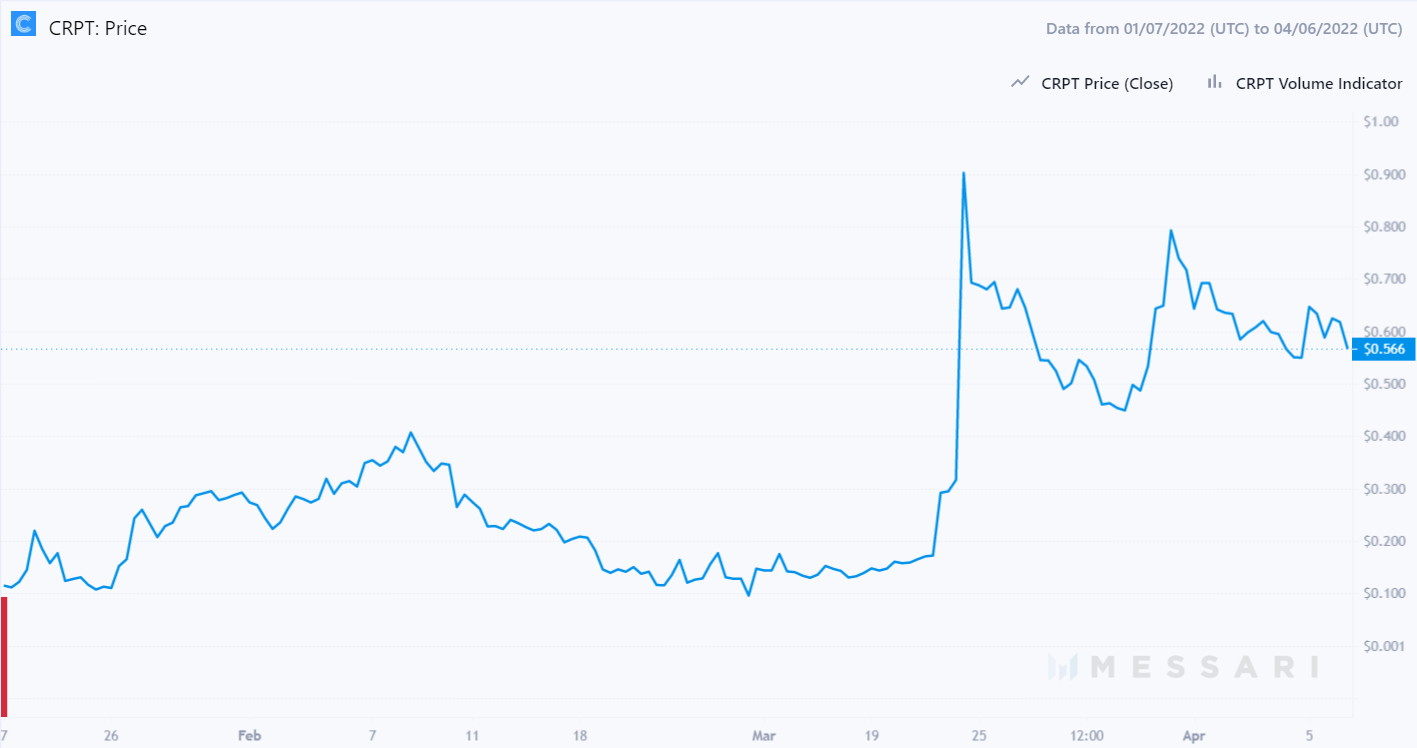
Cryptory (CRPT)
Price: $0.589912
Market Cap: $46.10 million
Monthly profit: +306%
Crypterium (CRPT) is one of the native tokens of Choise.com’s MetaFi (CeFi/DeFi) ecosystem, built on top of the Crypterium CeFi and Charism DeFi protocols, which are reinventing how protocols work with CeFi.
Source: Messari.io
After listing CRPT on Coinbase, Huobi, and Crypto.com, the token’s price skyrocketed and trading volume continued to grow.
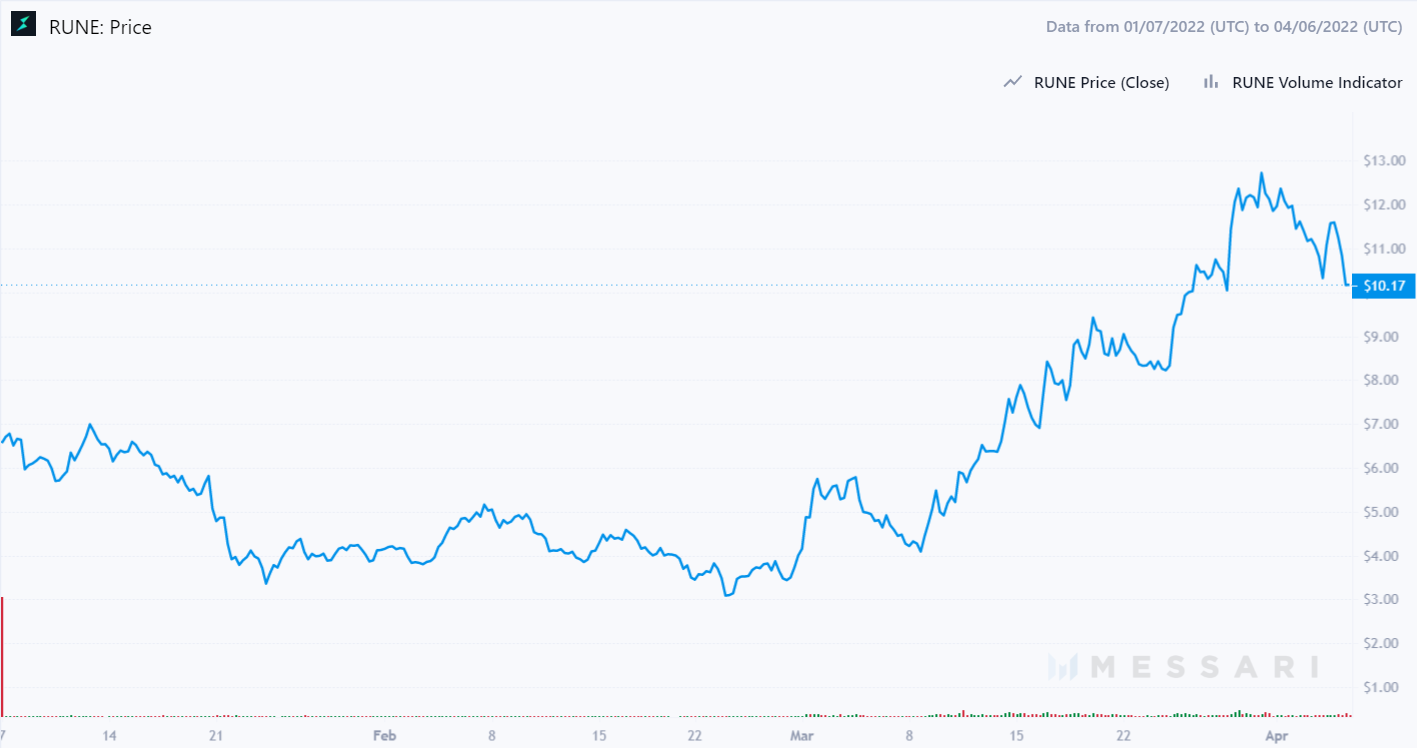
THOR Chain (RUNE)
Price: $10.17
Market Cap: $3.37 billion
Monthly profit: +139.85%
ThorChain’s consensus algorithm is proof-of-stake and based on Tendermint (Cosmos), requiring network validators (nodes) to bind their native token, RUNE.
ThorChain’s integration of synthetic assets has been one of the main factors contributing to RUNE’s growth. THORChain synths are unique in that they are backed by half the asset and half RUNE instead of 100% of the asset itself.
Source: Messari.io
To create synthetic versions of digital assets, users add RUNE or the underlying crypto assets to a THORChain liquidity pool. As network usage increases, the value of RUNE increases. As more liquidity flows into ThorChain’s liquidity pools, the value of RUNE increases. It has thus outperformed Bitcoin by 100.74% month-on-month.
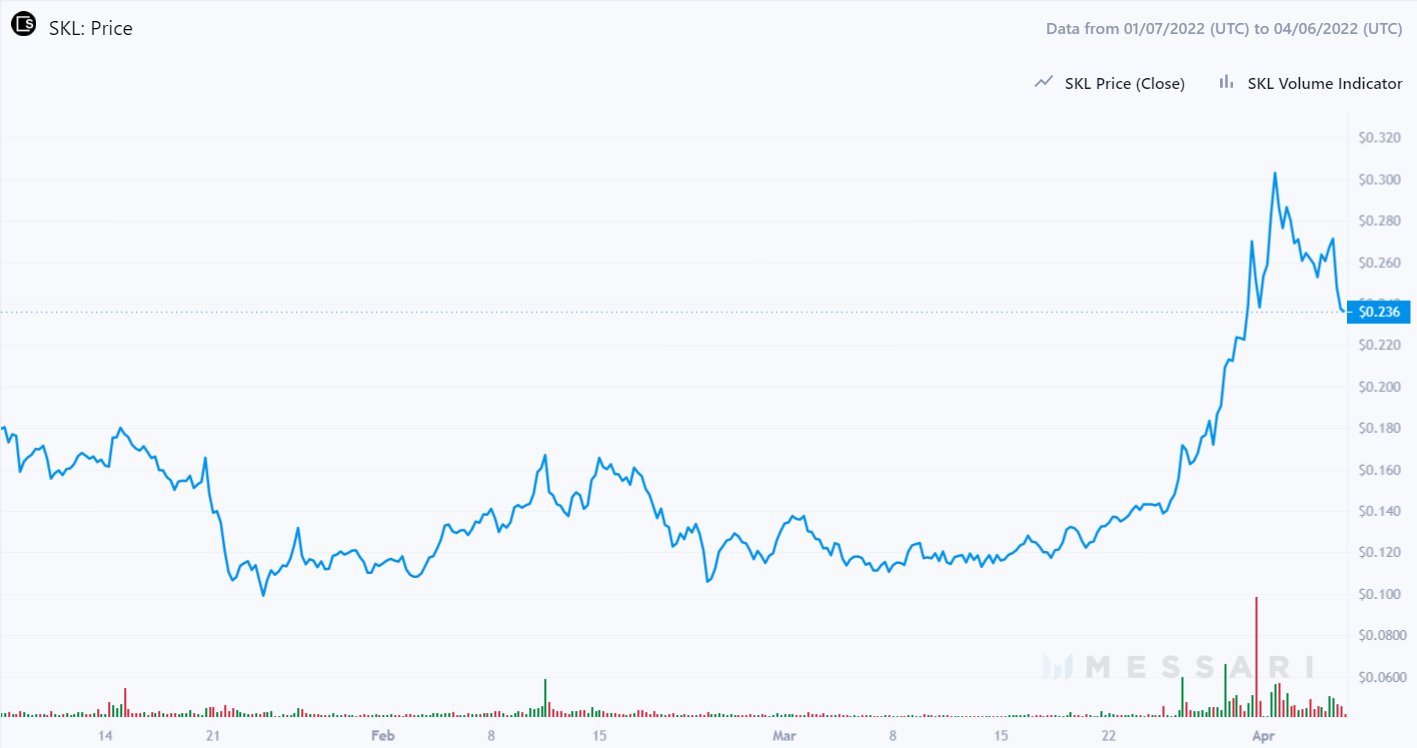
SKALE network (SKL)
Price: $0.234
Market Cap: $813 million
Monthly profit: +114.35%
The SKALE network is an open-source, decentralized blockchain network for scaling Web3 applications. A layer above Ethereum, SKALE chains are configurable, application-specific blockchains. They can run full-state smart contracts, run rollup contracts (a Layer 2 scaling solution), support decentralized storage, and run machine learning algorithms with the EVM, making Web3 apps cost- and performance-competitive.
Interest in SKL surged ahead of the launch of SKALE v2.0 and due to the project’s increased presence at a recent NFTLA networking event hosted by Blockdaemon.
Source: Messari.io
SKL has moderate volatility with a low risk-reward ratio, meaning there is little price manipulation and the token has moderate price swings. It outperformed BTC by 92.42% month-on-month.
Learn Crypto Trading, Yield Farms, Income strategies and more at CrytoAnswers
https://nov.link/cryptoanswers
Comments are closed.