


overview
Boosted pools are actually a subclass of other pools (typically composable stable pools and weighted pools), but deserve a page of their own due to their powerful feature set. Boosted Pools offer Liquidity Providers (LPs) and traders the best of both worlds. Traders get access to high liquidity with minimized price impact, while liquidity providers have their liquidity positions sent to external protocols like Aave.
motivation
In liquidity pools, swap prices are determined by pool balances. A large pool is great for traders: the larger the balances in the pool, the less the price will change on a given trade. The downside, however, is that large pools don’t lend themselves well to LPs. While the full amount of balances supports the token prices, only a fraction of the balances in the pool are actively traded back and forth to facilitate trading. As a result, much of the pool sits unused.
Advantages
Better for LPs, better for dealers
How can changes in pool structure improve the LP experience? By using the unused liquidity to add value in other ways. With this untapped liquidity in other protocols, LPs can get a boost (e.g. Aave borrowing fees) and the pool becomes more enticing than other pools. As the pool is more attractive to LPs, liquidity becomes even greater and offers traders even better prices.
High capital efficiency
Boosted pools are designed to provide high capital efficiency by allowing users to provide trading liquidity for shared tokens while also forwarding unused tokens to external protocols. This gives liquidity providers the benefits of protocols like Aave on the swap fees they charge from trades.
Super liquid consolidated liquidity
Nesting pool tokens creates a powerful way to trade between any stablecoin and any aToken in the Boosted Pool. Additionally, each token in a pool alongside a Boosted Pool Token can directly access the underlying tokens.
Crucial building blocks: linear pools
To understand boosted pools, it’s important to understand their core building block: linear pools.
Linear pools are balancer pools that facilitate the exchange of an asset and its packaged, income-producing counterpart at a known (calculated or polled) exchange rate. For example DAI and packaged aDAI from Aave. Linear pools have target ranges to incentivize how much of the native token should be kept available for swaps versus its yield-bearing counterpart. They use a fee/reward mechanism to incentivize arbitrageurs to maintain a desired ratio between the two tokens (paying fees for going out of range, receiving a reward for coming back in). Another important feature of Linear Pools is that they allow users to trade directly with BPT; No joins or exits are required.
Nesting linear pools
Since BPTs are themselves ERC-20 tokens, linear pool BPTs can be nested in another pool. This creates an easy BatchSwap path between underlying assets and tokens in the outer pool, as traders can switch from BPT to any of the underlying linear pool tokens.
Example
Let’s say there is a hypothetical new weighted pool with two tokens: 50% USDC and 50% WETH. Swaps in this pool can be expected to touch only a fraction of its depth (ie swaps will typically not use more than ~20% of the balances in the pool as trades of this magnitude would change the price significantly).
As the figure above shows, only a small portion of the pool would be touched by swaps. The remaining assets are in the pool to compose the price and reduce price impact, but are idle and therefore generate no direct returns or fees. Boosted pools aim to optimize a pool’s asset utilization.
If this were built as a Boosted Pool instead, the idle assets could become yield-bearing versions on a hypothetical protocol, ProtocolX, with xTokens being yield-bearing versions of their base tokens. By boosting this pool with nested linear pools, the previously weighted vanilla pool becomes far more efficient.

Case study: bb-a-USD
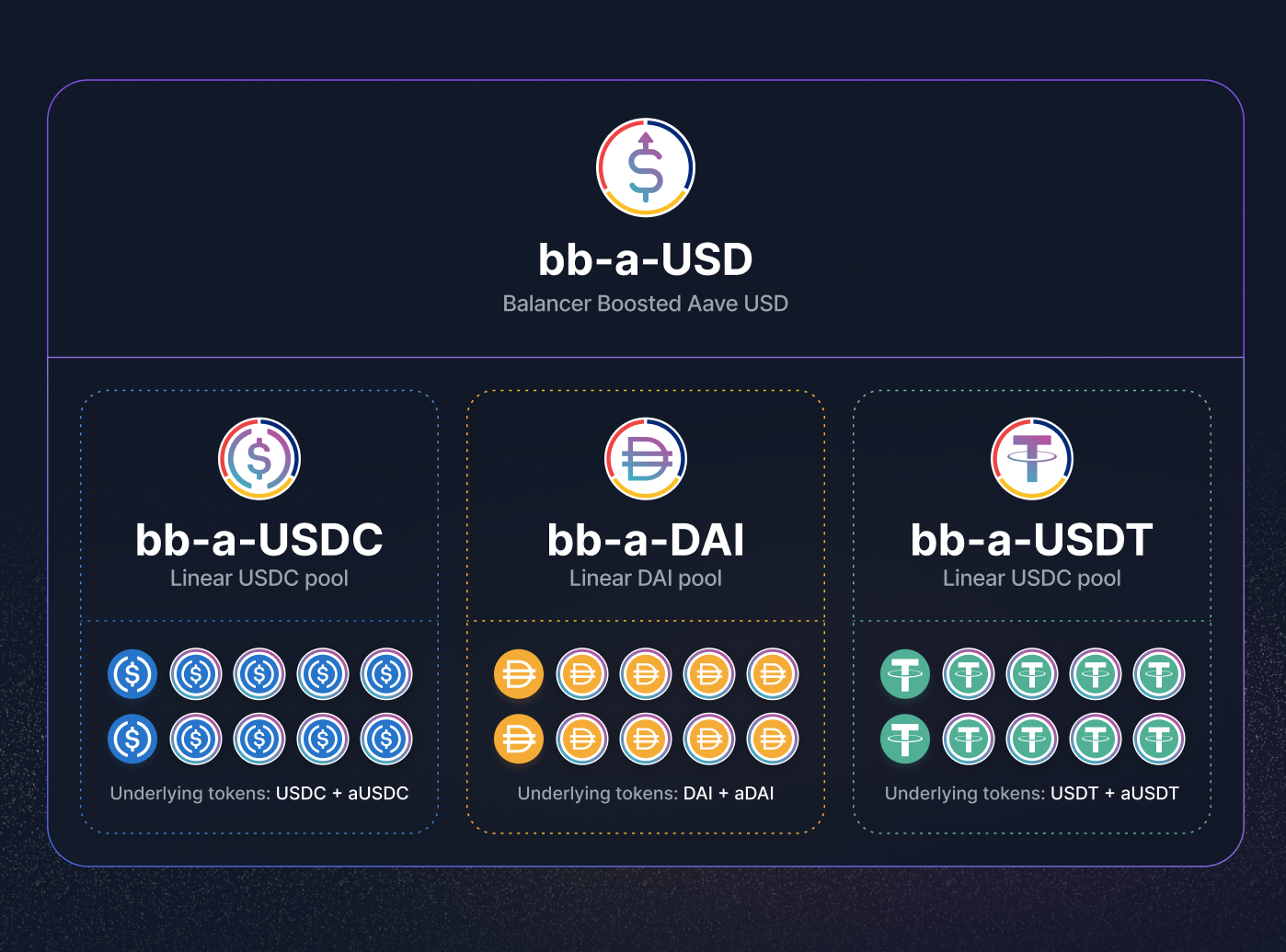
Balancer Boosted Aave USD (Symbol: bb-a-USD) is a composable stable pool that facilitates trading between three US dollar stablecoins (USDC, USDT, and DAI) while sending unused liquidity to Aave. The underlying linear pools are:
- bb-a-USDC (consisting of USDC and packaged aUSDC)
- bb-a-USDT (composed of USDT and wrapped aUSDT)
- bb-a-DAI (consisting of DAI and packaged aDAI)
Why are the aTokens wrapped?
aTokens are not compatible with the Balancer Vault as they have streaming credit. These tokens must be wrapped in a static token that takes into account all accumulated values.

bb-a-USD as pairing token
bb-a-USD has pre-minted BPTs that allow it to be nested in even higher level pools. When creating a pool, using bb-a-USD as a constituent token offers a number of advantages:
- Easily access swap paths for multiple USD tokens without fragmenting stablecoin liquidity
- Benefit from LPs with additional boost from Aave
Aave USD MetaPool
If a protocol or organization has a new stablecoin for which they wish to establish increased liquidity, they do not need to source independent liquidity for alternative stablecoins. Instead, they can pair their new token’s Aave Boosted Linear Pool with bb-a-USD. This reduces liquidity fragmentation and simplifies the onboarding process.
Weighted Pool Pairing
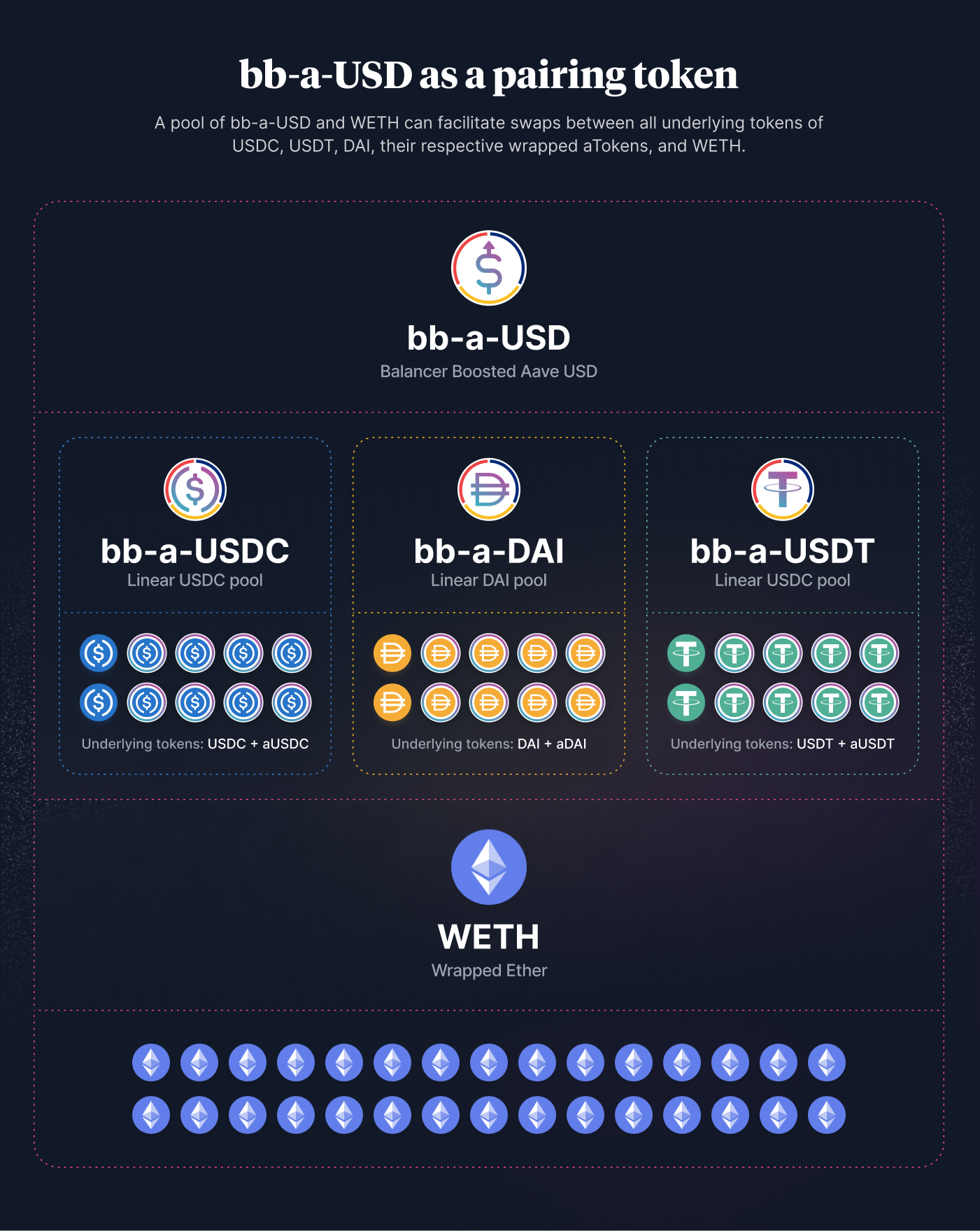
For example, a pool of bb-a-USD and WETH can facilitate exchanges between all underlying tokens of USDC, USDT, DAI, their respective wrapped aToken and WETH.
Learn Crypto Trading, Yield Farms, Income strategies and more at CrytoAnswers
https://nov.link/cryptoanswers
Comments are closed.