
BTC and ETH are protected from 51% attacks, Coin Metrics cites the use of cost barriers


Crypto intelligence firm Coin Metrics has revealed in its latest research that it has become impractical for nation-states to destroy the BTC and ETH network through 51 percent attacks given the prohibitive costs involved.
A 51 percent attack is about gaining majority control of a network's hash rate in proof-of-work systems like Bitcoin or staking in proof-of-stake networks like Ethereum, allowing possible manipulation of the Blockchain enables.
The study, conducted by Lucas Nuzzi, Kyle Waters and Matias Andrade of Coin Metrics, introduces the Total Cost to Attack (TCA) metric to estimate the costs associated with such malicious activities. Their findings suggest that an attack on Bitcoin (BTC) or Ethereum (ETH) would be neither financially feasible nor profitable for attackers, essentially eliminating the incentive for such actions.
9 We also find no way for a nation-state attacker to continuously conduct a 51%/34% attack if the goal is to destroy these networks.
The possibility of retaliatory techniques makes ideologically motivated attacks costly with each round of retaliation.
In the end, the network survives.
— Lucas Nuzzi (@LucasNuzzi) February 15, 2024
For Bitcoin, attempting to gain control would require acquiring about 7 million ASIC mining rigs, representing an investment of about $20 billion. However, the market lacks the availability of such a large number of ASIC rigs, and even if a potential attacker decided to produce them, the cost would still be over $20 billion.
Manufacturing S9 mining rigs would cost over $20 billion | Source: Coin Metrics
The scenario not only makes the attack impractical but also economically inefficient, with the most advantageous double-spend attack yielding just a 2.5% return on a hypothetical spend of $40 billion to gain $1 billion .
Ethereum is facing a similar situation with the move to a proof-of-stake model, with the report assessing the feasibility of a 34 percent attack by Lido validators. The analysis concluded that any attempt to compromise the Ethereum network using Liquid Staking Derivatives (LSDs) would be both costly (over $34 billion) and time-consuming, and due to the churn limit requiring immediate staking Stakes restricted, would take up to six months.
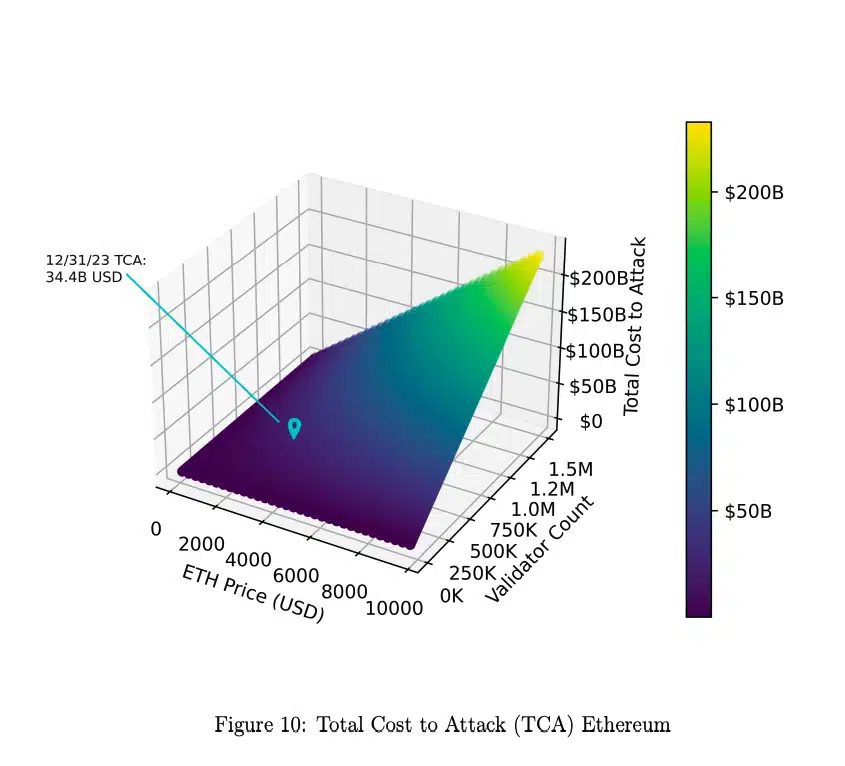 An attack on Ethereum with LSDs would cost over $34 billion | Source: Coin Metrics
Additionally, the logistical challenge of managing over 200 nodes and incurring significant costs, such as $1 million for Amazon Web Services, further reduces the plausibility of such an attack.
Nic Carter, partner at Castle Island Ventures, praised the report for its detailed and empirical examination of the infeasibility of 51% attacks on these leading cryptocurrency networks.
He noted that previous analyzes lacked the concrete, data-driven approach seen in Coin Metrics' research, calling it a critical contribution to understanding the security and resilience of Bitcoin and Ethereum to potential threats at the nation-state level.
Previous analyzes of Bitcoin’s “cost of attack” have been vague or theory-based. no longer. The CM team developed Mine-Match, which meant they could identify virtually any ASIC mining on Bitcoin (based on Karim Helmy's research). This, combined with ASIC 2ndary…
– nic 🌠 op_cat-er (@nic__carter) February 15, 2024
Learn Crypto Trading, Yield Farms, Income strategies and more at CrytoAnswers
https://nov.link/cryptoanswers
Comments are closed.