


Photo by Movus/iStock Editorial via Getty Images
Investor Thesis
Not only is Coinbase (NASDAQ:COIN) the largest cryptocurrency exchange in the United States, it’s also one of the biggest exchanges in the world. The company bucked the traditional IPO course this year and went public via a direct listing last month. Coinbase has roughly 50 cryptocurrencies available for trading – led by Bitcoin (BTC-USD) and Ethereum (ETH-USD) – and is planning to add a bunch more to its portfolio as investor interest in cryptocurrency soars.
In this article, we’ll analyze the risk/reward of Coinbase, go over the company’s record-setting quarter, take a look at why shares have plunged, and how Bitcoin’s recent fall is Coinbase’s gain. We believe the company has more than 70% upside from current levels and presents a great risk/reward opportunity for investors.

Source: Company website
Why Shares Have Fallen
Coinbase didn’t go the traditional IPO route when it went public last month. Instead, the company did a direct listing, following other tech companies like Spotify (SPOT), Slack (WORK), Palantir (PLTR), and Roblox (RBLX) who helped pave the wave.
On April 14, 2021, Coinbase made its debut on the Nasdaq as shares opened up at $381 and quickly rose to what is now the 52-week high of $429. Shares ended up closing the day at $328.28, giving the company an initial market cap of nearly $86 billion. While it closed near the low of the day, shares were still well above the reference price of $250.
Fast forward a month later and shares are now well below the reference price of $250, and well below the average analyst price target of $388.92.
So what’s caused the sudden doom and gloom of this fast-growing and very profitable company? We believe there are five factors that have contributed to the share price downfall.
1) Bitcoin – While Coinbase offers more than 50 cryptocurrencies and is looking to add a bunch more this year, much of the focus has been tied to Bitcoin. If Bitcoin goes up, so does Coinbase’s share price and vice versa. The chart below illustrates this perfectly as the two continue to trade in almost lockstep with each other. We’ll go into more details throughout this article; however, it’s important that investors realize that Bitcoin is just a piece of the puzzle and eventually the two won’t be so closely tied to each other like they have been.
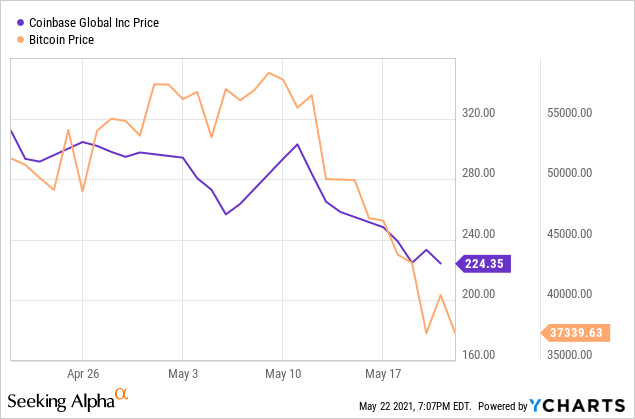 Data by YCharts
2) Timing – Another contributing factor has been the unfortunate timing of the market. Growth and technology stocks across the board have taken a beating as investors chase after reopening, value and energy play. Coinbase fits both of those categories (growth and tech) and has seen its share price tumble.
Also, the week of Coinbase’s direct listing was also the same time as Bitcoin’s all-time high. Coincidence? No. With all the hype around Coinbase and its listing, investors and traders drove Bitcoin to extreme levels ($63,000+) and then sold on the event. It was Wall Street’s classic “buy on rumor, sell on news” event. And from that moment on, Bitcoin’s move lower – after soaring 500% in seven months – has taken shares of Coinbase down with it.
 Data by YCharts
We expect Bitcoin to form a bottom around the $30K range. If that doesn’t hold, $22-23K is the next level to watch. With institutions, companies, etc., starting to adopt Bitcoin, we don’t see Bitcoin falling past that level.
Based on the trading history between the two, if Bitcoin were to settle into the $30K range, shares of Coinbase would likely be sitting around $200 based on current market sentiment. If Bitcoin drops to the $22K-$23K range, shares of Coinbase would likely be in the $170 range. However, this all depends if the market continues to value Coinbase based on Bitcoin’s performance – which it should not as we’ll explain.
Remember, the mission of Coinbase is to create an open financial system and is building what it calls the “Cryptoeconomy.” The company should not be valued on Bitcoin’s performance, because Coinbase makes money from cryptocurrency transactions. The more volatile Bitcoin, Ethereum, etc., are, the more transactions and revenue Coinbase makes.
Twitter: JG Investment Research
3) New – Coinbase just went public, it’s relatively new and many investors and traders are still trying to understand the company. This is why shares are trading alongside Bitcoin at the moment, but that should change in the coming time as Wall Street starts to value the company based on its fundamentals and moves (acquisitions, adding more cryptocurrencies, etc.) rather than what Bitcoin is doing at the moment.
4) Insider Selling – Another reason why shares have plunged is because the company skipped the traditional IPO process and went with a direct listing instead. This move allowed employees and existing shareholders to sell shares immediately, whereas IPOs have lock-up periods, restricting insiders from selling for several months. However, without the lock-up period, Coinbase insiders and early investors sold roughly $5 billion in stock on the first day. Insiders have continued to sell tens of millions of shares which has only added to the selling pressure.
5) Crypto Regulations + Tesla News – On Wednesday, Chinese regulators cracked down and tightened restrictions that ban financial institutions and payment companies from providing services related to cryptocurrencies. While the ban is for financial institutions, the crackdown does not prohibit individuals from holding cryptocurrencies.
Financial institutions in China issued a joint statement warning about the dangers of cryptocurrencies due to their speculativeness and volatility. Here’s what they said:
“Recently, cryptocurrency prices have skyrocketed and plummeted, and speculative trading of cryptocurrency has rebounded, seriously infringing on the safety of people’s property and disrupting the normal economic and financial order.”
This comes right after Elon Musk announced that Tesla (TSLA) would no longer accept bitcoin as a form of payment, sparking the massive selloff.
On Tuesday, the company announced a private offering of $1.25 billion of convertible senior notes. The senior notes, which will mature in 2026, will be convertible at an initial conversion rate of $370.45 per share, a 65% premium to Friday’s closing price of $224.35. The following day, among the cryptocurrency selloff, shares of Coinbase hit a 52-week low ($208), before closing the day at $224.80. With the offering, combined with the Tesla and China news, as well as insiders selling and investors rotating out of growth and tech stocks, it’s not hard to see why shares have fallen more than 30% since going public. But as we outline, this only makes our conviction stronger as the company is now trading at very undervalued levels. In our view, the stock is a no-brainer at these levels.
Q1 Takeaways
Talk about high expectations.
Coinbase reported Q1 revenues of $1.80 billion for revenue growth of nearly 850% on a year-over-year basis and more than 200% compared to the previous quarter. Yet despite the massive surge in revenue, the results still missed expectations as Wall Street was expecting $1.81 billion across the top line.
On the bottom line, the crypto giant fell just short again as it reported earnings per share (“EPS”) of $3.05, missing the consensus estimate of $3.09. Aside from this, the quarterly report was solid across the board. The company’s net profit for the quarter jumped to $771 million, more than 4X higher than the previous quarter and 24X higher on a year-over-year basis.
The company reported substantial user growth as the crypto giant had 56 million users, compared to just 34 million users last year. The new users include more than 8,000 institutions and more than 134,000 ecosystem partners in more than 100 countries. Retail Monthly Transacting Users (MTUs) also grew to 6.1 million in Q1 2021, more than doubling compared to the previous quarter. Trading volume soared from $30 billion to $335 billion and assets on platform grew from $17 billion to $223 billion.
Another positive for investors is that the crypto market capitalization reached nearly $2 trillion at the end of Q1 2021, compared to $782 billion at the end of Q4 2020. And because Coinbase makes the majority of its revenue through transactions, seeing user growth and the crypto market soar is just what the doctor ordered. Below are some of the key metrics over the past five quarters.
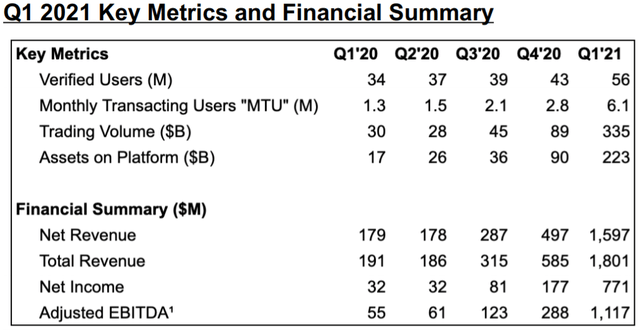
Source: Shareholder Letter
Again, we can’t stress enough the importance that investors understand that Coinbase makes 95% of its money from transactions. The whipsaw and volatility in cryptocurrencies are a great thing for shareholders. The more trades and transactions mean more revenue for the company. Slow and steady moves are not going to drive transactions. Volatility in cryptocurrencies is exactly what you want to see if you are a Coinbase shareholder and Bitcoin’s recent 50% plunge and recovery is driving plenty of transactions. This isn’t new to Bitcoin either as it has gone through plenty of massive swings over the years and this volatility is exactly why Coinbase has a bright future.
Based on Q1 results and management’s upbeat tone regarding Q2, the company will likely see revenue around $7 billion this year. This is well above analyst forecasts with consensus being $6.2 billion.
With EPS of $3.05 last quarter and the company on track to deliver similar results for Q2, that would amount to EPS of $6.10 through the first two quarters. Current analyst estimates have the company earning $9.56 this year, which seems awfully low considering the company said that it expects that all of its business metrics to meet or exceed the results recorded in Q1.
We are currently forecasting that EPS will come in between $10-$11 this year. One analyst even thinks the Coinbase can deliver EPS of $12.30 this year.
On a price to earnings (“P/E”) basis, we assign a P/E of 35 to Coinbase, which would give the company of price target of $367.50. Of course, you can put in any multiple you want to create your own price target, but based on high-growing and profitable companies, a P/E of 35 is still pretty low. At the end of the day, it really just depends on the mood of the market, and based on Coinbase’s anticipated revenue growth this year (400%+), combined with competition worries, we wouldn’t be surprised to see the market give the company a P/E in the 25-40 range. Below is a price breakdown of each of those multiples. Even on the low end, this would represent upside of nearly 20% from current levels.
| P/E Ratio | Price Target |
| 25 | $262.50 |
| 30 | $315 |
| 35 | $367.50 |
| 40 | $420 |
*Based on our midpoint EPS guidance of $10.50 for 2021
Based on these multiples, this would represent upside of 18%, 40%, 64%, and 87% based on Friday’s closing price.
On a price-to-sales (“P/S”) basis, Coinbase currently trades at less than 7X forward sales. This is quite low considering the company will likely see revenues surge more than 400% this year. Just based on 10X and 15X sales this year, shares would be worth $336 and $505 respectively. This is still relatively low considering most growth/tech stocks are trading between 15X and 30X sales at the moment and are less profitable. In fact, companies like PayPal (PYPL) and Square (SQ), which have joined the crypto market, currently sport P/Es of 53 and 140 respectively, and trade at 8X and 13X sales.
With cryptocurrency still in its infancy as well as all the boom and bust cycles, it seems the market wants Coinbase to prove itself before giving it a premium valuation. As of right now, the average analyst price target is $388.92, representing upside of nearly 75%. Our 12-month price target is $375 (35 P/E or 11X sales), which we feel is conservative given that Coinbase is expanding its product offerings (Dogecoin (DOGE-USD), etc.) and should continue to see strong user and revenue growth.
Lastly, the company increased its cash position by more than $900 million in Q1 and now has $1.98 billion in cash and cash equivalents ($9.50 in cash per share). The company is on track to have a similar if not better quarter in Q2, and if that’s the case, the company will have roughly $3 billion in cash or $14.42 in cash per share.
Conclusion
Yes, everyone wants to become a millionaire overnight.
And with the way Bitcoin and Ethereum had been going over the past six months, many investors were on their way. At their height, and before the fall, both cryptocurrencies were up nearly 300% and 700% respectively.
But as fast as they rose, the drop is going by even quicker as Bitcoin plunged as much as 30% on Tuesday, with Ethereum dropping more than 40%. Both of them gained much of it back by the end of the day. This isn’t anything new as crypto has always been very volatile, which makes owning Coinbase a no-brainer.
Up one day, down the next. Soaring one day, plunging the next. That’s the story of cryptocurrencies and all that buying and selling is stuffing the pockets of Coinbase. In fact, volume reached 126 billion last Tuesday, which was the most since February, and the second-most in Bitcoin history.
Last week we had China calling for tighter crypto regulation, Elon Musk saying Bitcoin is the future, before backtracking and announcing that Tesla will stop accepting bitcoin for car purchases. Then you have people like Tom Lee and Cathie Wood who recently said that they believe bitcoin is headed to $125,000 and $500,000. Yes, there is a lot of noise out there, but at the end of the day, it doesn’t matter where Bitcoin goes, so long as Coinbase can continue to grow its user base and keep reaping those transaction fees and pushing revenues higher.
Every stock has some risk and Coinbase isn’t immune to that. The biggest question surrounding the company is if cryptocurrency is just a fad, or if it’s here to stay. Investors aren’t going to pay a premium for a one-trick pony. Bears argue that crypto got hot due to COVID-19 and because everything was shut down. They argue that as the economy reopens, trading volume and interest will decline, thus making Coinbase a one-trick pony that merely benefited due to the pandemic.
However, if that was the case, then why are so many companies and investment banks getting into the business? The fact is that crypto is becoming a huge industry and research firms say it could reach $3 trillion by 2025 and more than $5 trillion by 2026. Professional athletes, celebrities, etc. are wanting to get paid in crypto now and the adoption should only continue. We believe cryptocurrency is here to stay and while competition could force Coinbase to lower its fees in order to keep and gain new users, we believe the market is big enough for many players.
Crypto is still in its early stages and Coinbase will continue benefiting from its first-mover advantage, strong brand, and international presence. As the company continues to expand its offerings to broaden its pool of investors, the crypto giant should have no problem growing as it looks to build the cryptoeconomy.
With upside of 70%+ ($375+) and downside of 10% ($200), we feel that Coinbase offers investors a great risk/reward opportunity.
Risks
1) Coinbase makes nearly all of its revenues from transaction fees. With so many players trying to get into the crypto space, Coinbase might have to lower its fees in order to compete for new or existing customers. Of course, lowering transaction fees would hurt the top and bottom lines; however, you could argue that it’s already been priced in based on Coinbase’s valuation. According to Coinbase CEO Brian Armstrong, he hasn’t seen any evidence of market compression yet – and doesn’t expect to in the short to medium term.
2) Staying on top also means staying innovative, giving customers more products (coins), and spending money. Coinbase has a nice cash position; however, they still announced a private offering of $1.25 billion of convertible senior notes. If the company is looking at doing acquisitions, it will likely have to raise more cash as it looks to defend its turf in the crypto space.
3) A large portion of Coinbase’s revenue is derived from transactions in Bitcoin and Ethereum. If demand for these crypto-assets declines and is not replaced by new crypto asset demand, the company’s business would be adversely affected.
4) Lastly, if too many investors/traders get burned from trading cryptocurrency – due to its large price swings – user growth and transaction fees could decline, thus hurting the company’s top and bottom lines.
Learn Crypto Trading, Yield Farms, Income strategies and more at CrytoAnswers
https://nov.link/cryptoanswers
Comments are closed.