


Leon Neal
Coinbase Global, Inc. (NASDAQ: COIN) shares fell 14% yesterday (February 9) as rumors of a possible SEC ban on crypto staking in the United States surfaced. These rumors were sparked when popular crypto exchange Kraken agreed to pay $30 million to settle SEC allegations that its staking products violate securities laws in the United States. As part of the deal reached with the SEC, Kraken will also discontinue its staking products in the US, but these products will be available to international traders through a subsidiary of the company. With the SEC promising to tighten its grip on the crypto industry given the risks associated with many crypto products, investor fears stemming from Kraken’s settlement with the SEC seem justified. This analysis aims to shed light on how crypto staking works, the importance of Coinbase’s staking business, and the prospects for this business Segment.
What is crypto staking?
From a trader’s perspective, staking is the practice of locking some or all of the crypto assets owned by an investor for a percentage return. Each cryptocurrency uses a consensus mechanism to validate and verify transactions to add them to the blockchain. There are two widely used consensus methods.
- Proof of Work – used by Bitcoin (BTC-USD).
- Proof of Stake – used by Ethereum (ETH-USD), Cosmos (ATOM-USD), Cardano (ADA-USD), Solana (SOL-USD), etc.
For staking to be allowed, traders must own cryptos that use the Proof-of-Stake consensus mechanism, which is why Bitcoin does not facilitate crypto staking.
Proof of Stake transaction verification works via crypto investors who stake their cryptos to validate those transactions against rewards in the form of cryptos. The functionality of crypto staking is therefore similar to crypto mining. Becoming a staking validator requires significant investment in hardware and technical knowledge, but the world’s major crypto exchanges offer simple staking products where traders can stake their holdings against potential rewards with just a few clicks.
Figure 1: The dynamics of crypto staking

CNBC
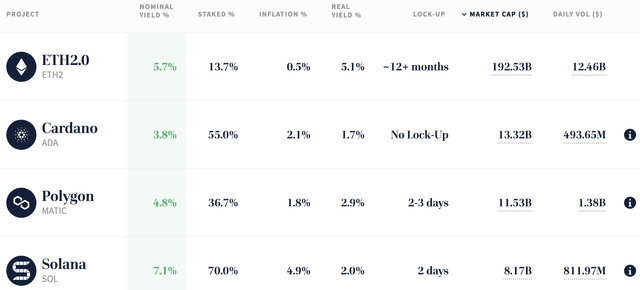
Ethereum switched to a proof-of-stake consensus mechanism last year, and this decision has boosted the staking business of many crypto exchanges worldwide. Shown below are the earnings associated with various cryptocurrency staking projects in the United States.
Figure 2: Returns of various crypto staking products
staked out
The SEC believes that some of these staking programs need to be registered as offerings of securities due to their characteristics, and the SEC claims Kraken has not done so.
Coinbase CEO defends the company
In a statement announcing Kraken’s settlement, the SEC quoted its Chairman Gary Gensler as saying:
Whether through staking-as-a-service, lending, or otherwise, when offering investment contracts in exchange for investor tokens, crypto intermediaries must provide the appropriate disclosures and safeguards required by our securities laws. Today’s action should make it clear to the market that staking-as-a-service providers must register and provide full, fair and truthful disclosure and investor protection.
The SEC’s problem is staking-as-a-service providers who draft contracts that resemble traded securities but avoid registering them with the SEC. In a statement to Bloomberg, Paul Grewal, Coinbase’s Chief Legal Officer, said:
Coinbase’s staking program is unaffected by today’s news. It is clear from today’s announcement that Kraken essentially offers a yield product. Coinbase’s staking services are fundamentally different and not securities.
Coinbase CEO Brian Armstrong claimed on Twitter that he had heard rumors that the SEC would ban retailers from participating in crypto staking programs in the future, claiming that such a decision would harm consumers and also pose a threat to national security would represent.
Exhibit 3: Brian Armstrong’s tweet

Mr Armstrong went on to say that the growth of new technology in the US should be encouraged and urged regulators to find “reasonable solutions”.
Hester M. Peirce, who serves as commissioner of the SEC, released a statement yesterday criticizing the regulator’s decision on Kraken’s crypto staking program. She advocates using an effective regulatory framework to encourage new technologies while protecting consumers.
Crypto staking programs have been known to us for a long time. While it might not have made a difference, I should have called for a staking guide to be published long before that. Instead of considering staking programs and issuing guidance, we have again chosen to talk about an enforcement action that purports to “make it clear to the market that staking-as-a-service providers register and fully, fairly and.” provide truthful disclosure and investor protection.” Using enforcement action to tell people what the law requires in a burgeoning industry is not an efficient or fair form of regulation. In addition, staking services are not uniform, so one-off enforcement actions and cookie-cutter analysis are not enough.
The SEC seems laser-focused on investigating the crypto staking industry, despite opposition from the likes of Coinbase’s CEO.
Undermining the SEC’s threats could be fatal
Investors should be cautious about dismissing the threat posed by the SEC to Coinbase’s future as a crypto staking business. Coinbase executives’ argument is that the staking process does not involve a transfer of ownership of crypto assets from one investor to another entity. While this seems like a valid argument, the SEC could still ban the practice of crypto staking, in which case Coinbase will have no choice but to go out of business.
If Coinbase starts a battle with the SEC over its decision on Kraken, it wouldn’t be the first time the company has gotten into a dispute with the watchdog. Back in September 2021, Coinbase CEO Brian Armstrong accused the SEC of “patchy behavior” in a series of tweets due to the regulator’s failure to approve Coinbase’s proposed crypto lending product. Coinbase eventually had to scrap its crypto lending product later in the month as the SEC deemed those products too risky for retail investors.
Coinbase’s staking business
In the September quarter, Coinbase generated $62 million in revenue from staking services, accounting for nearly 11% of the total revenue the company reported for the quarter. Amid the ongoing decline in trading revenue, Coinbase investors have found solace in the company’s efforts to diversify its revenue by encouraging the use of non-investment products like staking. The company, on the other hand, has regularly highlighted the importance of this business segment for its future as a 360-degree crypto solution provider. Below are some comments from CEO Brian Armstrong in his third-quarter letter to shareholders.
While staking is being monetized at a lower rate compared to trading, we are excited about the growth in absolute revenue compared to the previous crypto winter when our staking products didn’t exist in earnest.
In Q3, compared to Q2, blockchain rewards benefited from increased staking participation – both in terms of the number of users and the number of native units staked across all assets supported on our platform became. The growth in staking users was mainly driven by Solana, which we’ve been supporting since June.
In Q3, we rolled out institutional staking for Ethereum globally, and while adoption is still in its infancy, we are optimistic about the long-term opportunity.
It’s clear that Coinbase sees the rising popularity of staking as an opportunity to meaningfully diversify its revenue streams. The characteristics of the staking business bode well for Coinbase’s long-term strategy of reducing revenue volatility.
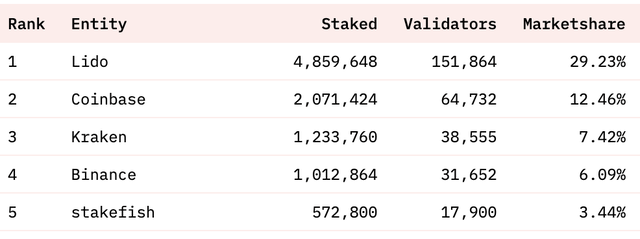
As the SEC continues to investigate the business practices of major U.S. crypto exchanges that offer staking programs, decentralized finance apps like Lido, Rocket Pool, and StakeWise stand to benefit the most. According to data from Dune, Lido is already the market leader in the Ethereum staking business, well ahead of Coinbase, which is in second place.
Figure 4: ETH players by amount wagered
dune
Decentralized apps like Lido are considered immune to regulatory headwinds due to the autonomous and anonymous capabilities of these platforms. Henry Elder, Head of Decentralized Finance at Wave Financial, commented on how the SEC’s action could prove to be a godsend for these platforms:
This is a huge boon to decentralized staking providers like Lido, Rocket Pool, and StakeWise. Their competitive advantage is an innate resistance to regulatory action—something that played little role in the absence of such action.
Investors and traders are likely to choose decentralized apps over Coinbase in the near term amid the dark clouds hanging over the staking programs offered by crypto exchanges. The SEC investigation could therefore have long-term implications for Coinbase’s staking business.
Bring away
Investing in Coinbase shares remains, in my opinion, the best way to gain exposure to the crypto industry, given that COIN’s positive correlation with Bitcoin prices will eventually diminish along with the success of the company’s non-investment business. However, the company’s staking business is likely to attract regulatory scrutiny, which could push share prices lower in the near term.
Learn Crypto Trading, Yield Farms, Income strategies and more at CrytoAnswers
https://nov.link/cryptoanswers
Comments are closed.