


Big banks like Credit Suisse are reeling and need bailouts, leading to the question: is your money really safe in traditional banking systems during a banking crisis? With bitcoin and other cryptocurrencies growing in popularity, it’s time to consider the role of these digital assets as potential safe haven assets.
But what are the possibilities and risks of storing assets in Bitcoin during banking crises?
The shaky ground of traditional banks
The global financial ecosystem is in a precarious state. The collapse of Credit Suisse, a global systemically important bank (G-SIB), has set off alarm bells around the world.
This failure, coupled with the fact that no banks have failed in the last decade of quantitative easing (QE), leads us to question the stability of our banking systems.
Historically, bank failures have been a natural part of free markets and have helped to de-risk excess. However, as governments and central banks expand the money supply at unprecedented rates, bank failures have become rare.
Is this a result of safer banking practices or just a by-product of the money printing and government bailouts that have shifted risk off bank balance sheets?
US Federal Reserve balance sheet. Source: Statistics
Countries like Canada have followed the G20 consensus, engaged in quantitative easing and issued debt to fund deficit spending. This practice has led to an increase in public and private debt-to-GDP ratios.
This trend can potentially inflate asset bubbles and contribute to economic instability.
Economist Joseph Barbuto has highlighted Canada’s high debt-to-GDP ratio. He has drawn comparisons to the US debt ratio during World War II.
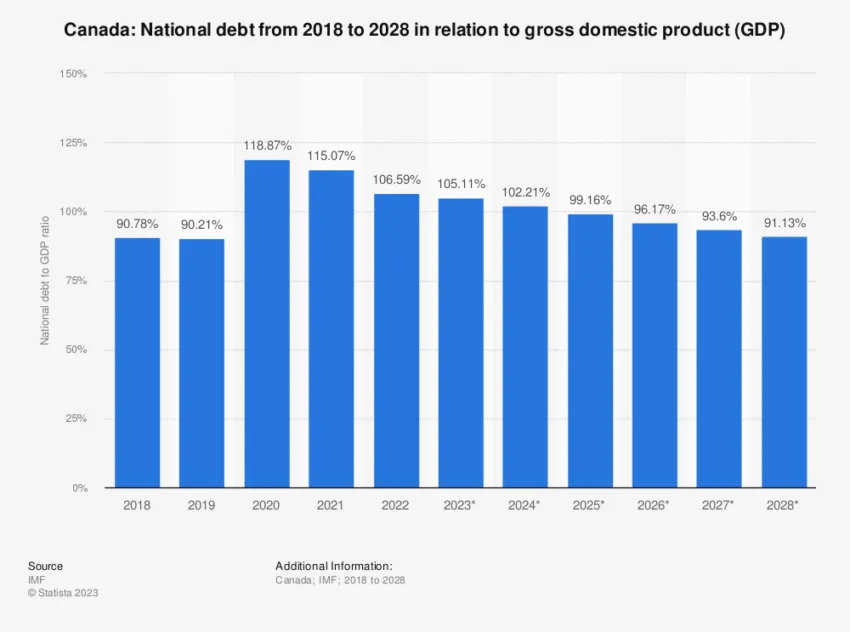 Canada’s national debt. Source: Statistics
This alarming rise in debt levels has sparked debate about the effectiveness of quantitative easing. Many economists accuse central banks of artificially manipulating interest rates and contributing to inflation.
The great retreat – a sign of lost trust
As confidence in banks dwindles, people are increasingly withdrawing their money. High interest rates are another factor encouraging depositors to seek higher returns in alternative investment vehicles.
This trend has led to a surge in digital bank runs with record-breaking withdrawals from traditional banks. For this reason, the practices of the banking industry are under scrutiny.
For example, banks earn about 5% interest on money parked with the central bank after buying government bonds during quantitative easing. Meanwhile, depositors receive a savings rate of about 0%.
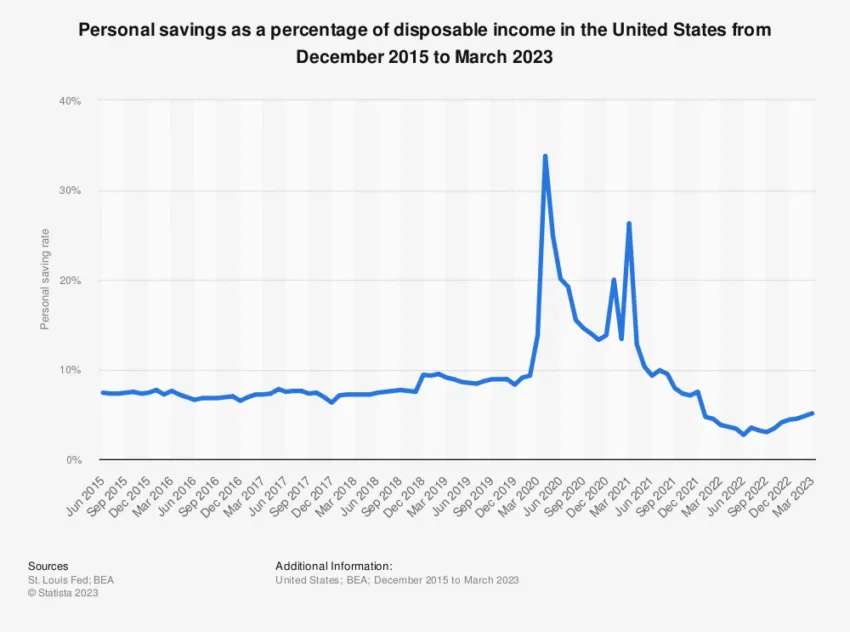 Personal savings as a percentage of disposable income. Source: Statistics
This unfair discrepancy leads people to transfer their savings to other assets, including bitcoin.
The banking crisis has resulted in three of the largest bank failures in US history, including Silicon Valley Bank, Signature Bank and First Republic Bank.
These failures have prompted a series of emergency Federal Reserve measures, including bailouts and lending programs designed to prevent losses on US Treasuries from realizing.
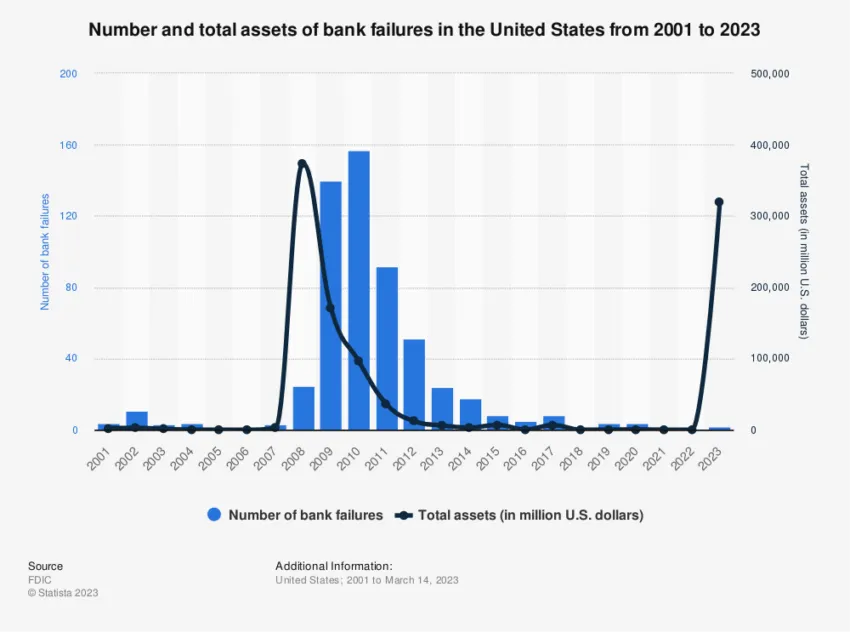 Total assets of bank failures in the US. Source: Statistics
However, the interference of central planners in the free market pricing mechanism has raised concerns. The Federal Reserve is now acting as a “loan shark” for small and medium-sized banks, potentially exacerbating the crisis.
Bitcoin – a Safe Haven Amid the Banking Crisis?
While traditional banking systems are under pressure, Bitcoin is proving to be a potential safe haven asset.
Despite its volatility, Bitcoin offers a decentralized and secure alternative to traditional banking. The digital asset is immune to inflation and government intervention, making it an attractive option during banking crises.
However, the transition to digital assets is not without risks. As with any investment, Bitcoin’s value can fluctuate, and it’s important to understand these risks before transferring wealth into digital assets. Still, bitcoin can provide some protection in times of banking uncertainty.
Due to its decentralized nature, it can operate independently of central banks and state control. This could offer a financial refuge for those looking to escape a possible banking crisis.
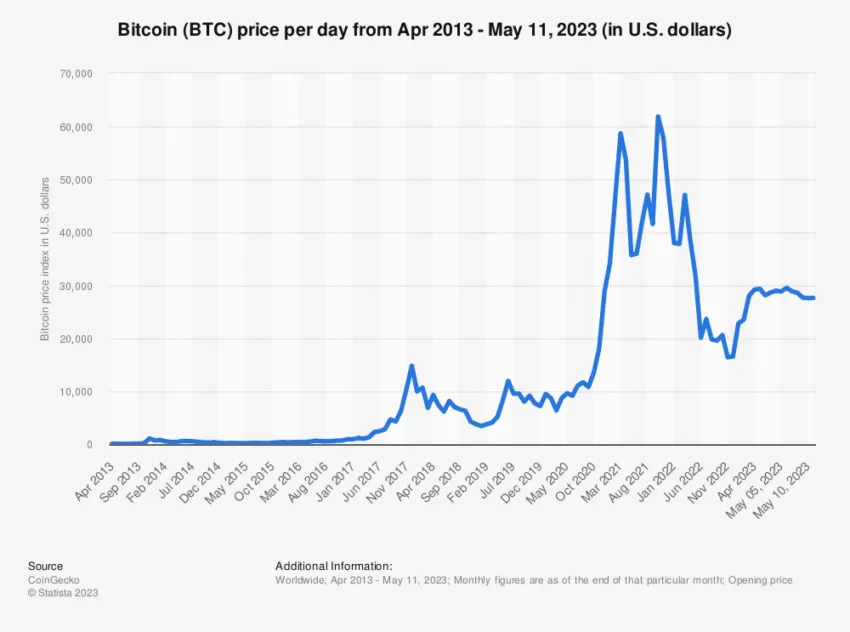 Bitcoin US Dollar Price. Source: Statistics
Although Bitcoin’s price is volatile, its value does not directly correlate to any particular economy, which can be beneficial when traditional financial institutions are unstable. Additionally, while governments can print more money and cause inflation, the supply of bitcoin is limited and offers some protection against currency devaluation.
Bitcoin’s potential as a safe haven in banking crises is not purely theoretical; Real-world events provide valuable insights.
For example, during Venezuela’s economic crisis, bitcoin usage surged as citizens sought to protect their wealth from hyperinflation. Similarly, after the Cyprus banking crisis of 2013, the price of bitcoin surged as investors sought safe havens.
 Global inflation forecast. Source. extra
While these examples do not prove Bitcoin’s absolute safety, they do illustrate its potential role as an alternative financial haven during banking crises. However, it is important to remember that Bitcoin comes with its own set of risks, such as price volatility and regulatory uncertainty.
Is your money safe in Bitcoin?
Investing in Bitcoin as a hedge against banking crises is not a one-size-fits-all strategy. It depends on individual circumstances, risk tolerance and understanding of cryptocurrencies.
While Bitcoin can offer potential benefits such as inflation protection and independence from traditional banking systems, it also poses significant risks.
It is therefore important for those considering bitcoin as an alternative to traditional banking to understand the dynamics of the crypto market, the technology underlying bitcoin, and the potential legal and financial implications.
The safety of bitcoin money during a banking crisis depends largely on how one defines “safe”. If security means preserving the purchasing power of one’s wealth amidst rampant inflation and banking instability, Bitcoin could potentially serve as a viable haven.
However, if security means maintaining a stable asset value, Bitcoin’s volatility could pose a significant risk.
While bitcoin can provide a financial haven during banking crises, it is not a guaranteed solution. It is a relatively new and rapidly evolving asset class that should be approached thoroughly and carefully, bearing in mind the risks involved.
Disclaimer
Following the Trust Project guidelines, this feature article presents opinions and perspectives from industry experts or individuals. BeInCrypto is committed to transparent reporting, however, the views expressed in this article do not necessarily reflect those of BeInCrypto or its employees. Readers should independently verify information and consult a professional before making any decisions based on such content.
Learn Crypto Trading, Yield Farms, Income strategies and more at CrytoAnswers
https://nov.link/cryptoanswers
Comments are closed.