


Crypto is much more influenced by US monetary policy than stocks. While there appear to be multiple reasons for this emerging trend, macroeconomist Tascha Che believes there are enough concerns that could underpin future market declines.
The tech investor, who prefers to be called just Tascha, pointed to three main factors: increasing institutional acceptance, massive increases in leverage, and crypto’s reliance on the US dollar as a funding currency and unit of account.
She spoke ahead of an upcoming busy month for crypto and traditional financial markets. US inflation data is due on Tuesday and the Federal Open Market Committee’s rate hike decision on September 21st. Both Ethereum and Cardano will undergo major network upgrades in September.
Crypto and massive institutional inflows
“Institutional money has more access to leverage and is more sensitive to changes in interest rates/funding costs, leading to greater reactions in crypto prices to changes in the macro environment,” Tascha outlined in a lengthy Twitter thread.
She said that corporate money is heavily invested in conventional finance, which “leads to greater spillover from stock markets to cryptocurrency when the former is impacted by macros. This is evidenced by the increasing correlation between stocks and crypto since 2020.”
According to Morgan Stanley Research, inflows from institutional investors grew from zero to over 70% of total cryptocurrency transaction volume between 2018 and 2021. That’s about $385 billion using Coinbase’s quarterly data as a proxy for the entire market.
Source: Coinbase, Morgan Stanley Research
Estimates suggest that crypto prices have been more sensitive to the US monetary contraction than stocks over the past cycle – meaning that a Federal Reserve rate hike would “damage the crypto industry a lot more” than stocks.”
It’s pretty ironic, says Tascha, given the bitcoins [and cryptocurrency’s ] Main selling point as a “hedge” against volatility in traditional financial markets and inflation. On the contrary, crypto has become increasingly correlated with stock markets in recent months.
This year alone, billions of dollars have exited crypto markets, paralleling declines in tech stocks on the Nasdaq as U.S. economic output shrank and the Federal Reserve either signaled or hiked interest rates to curb inflation.
Companies are driving leverage
While Fed Chair Jerome Powell suggested in a recent speech that the U.S. economy needs tight monetary policy to bring inflation under control, Tascha said that a “massive increase in leverage” could mean more volatility for crypto.
She said the advent of decentralized finance in 2020 has led to a surge in on-chain liquidity, causing both leverage and the total amount of money locked up in DeFi money markets, liquidity pools and complex return products is, had shot up.
“The rapid growth of crypto derivatives on centralized exchanges has also fueled demand for leverage, which has been met by new inflows into crypto from again mostly institutional players,” she explained.
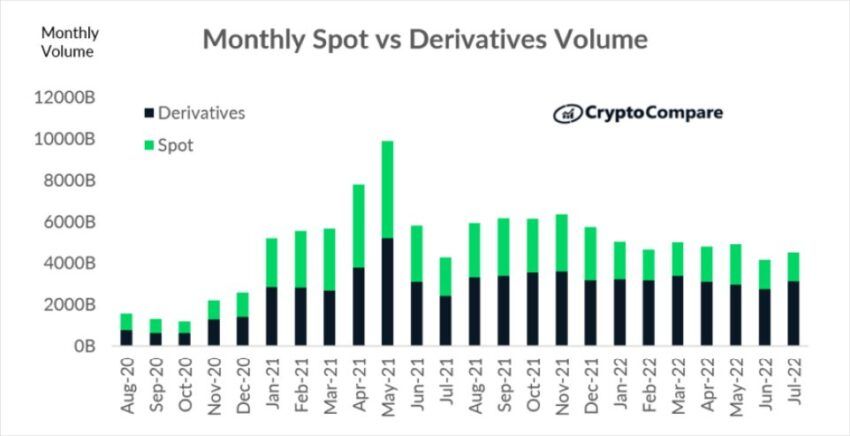 Source: CryptoCompare
And as several crypto companies like Celsius and Voyager exploded earlier this year, some DeFi die-hards have argued that “if everything lent/borrowed” it would be safer for the system since the loans would be over-collateralized and liquidated programmably.
But Tascha, the macroeconomist and tech investor, dismissed that as “wishful thinking.”
“Yes, DeFi may be less exposed to certain risks…but it magnifies other risks…resulting in more interconnected protocols and encouraging greater overall leverage,” she said, adding:
“The entry of institutional players increases demand and access to leverage in crypto. Higher leverage of the system amplifies the effects of stock market spillovers and dollar appreciation. The result is that Fed policy and the macro environment are having an even greater impact on crypto than on traditional financial markets.”
The dollar factor
Tascha also discussed the impact of the dollar on crypto markets in relation to US monetary policy actions. She said the use of the dollar as the primary funding currency and unit of account in the crypto industry is a major weakness.
The dollar is the largest fiat currency in the crypto market. Tokens are predominantly valued in dollars, USD stablecoins make up 95% of the stablecoin markets, and most credit and lending is done in USD stablecoins.
“But crypto is global and most users are outside of the US,” said Tascha, who has a Ph.D. in macroeconomics.
“If the USD appreciates, tokens will become de facto more expensive for non-US investors whose purchasing power is based on other fiats – mechanically reducing inflow into the cryptocurrency market.”
Do you have something to say about crypto or something else? Join the discussion on our Telegram channel. You can also reach us on Tik Tok, Facebook or Twitter.
Disclaimer
All information contained on our website is published to the best of our knowledge and for general information purposes only. Any actions taken by the reader based on the information contained on our website are entirely at your own risk.
Learn Crypto Trading, Yield Farms, Income strategies and more at CrytoAnswers
https://nov.link/cryptoanswers
Comments are closed.