


The traditional DeFi landscape is characterized by fragmented liquidity spread across multiple trading pools. This leads to economic inefficiency: more hops and less liquidity lead to higher price impacts and price swings. By pooling all liquidity into a single trading pool, the HydraDX Omnipool enables efficient trading like no other AMM.
Traditional AMMs: liquidity fragmentation
The pioneering XYK AMM model marked a pivotal moment for DeFi, enabling decentralized and permissionless trading. The simplicity of XYK pools fueled the initial adoption of DeFi, however today we are at a point where the resulting economic inefficiencies are impeding further adoption.
One of the flaws of the XYK model is that trading pools are limited to asset pairs. Fragmented liquidity leads to higher price impact due to more hops and slippage. The history of ETH AAVE trading in the screenshot above is a practical example:
- 85% directly from ETH to AAVE (for a fee of 0.3%);
- First, 15% of ETH is traded for UNI, then UNI is swapped for AAVE (incurring two 0.3% swap fees).
HydraDX Omnipool: Unified Liquidity
Thanks to the state-of-the-art design, the liquidity in the Omnipool really looks like a unit. By connecting all liquidity via LRNA, assets in the Omnipool have direct access to all liquidity of all other assets also deposited in the Omnipool. This enables a seamless execution in the chain and allows trades to be completed in a single transaction without the need to jump back and forth between different isolated trading pools.
Also, based on internal research, increasing the number of tokens and total locked value (TVL) within the Omnipool results in exponential improvements in slippage reduction.
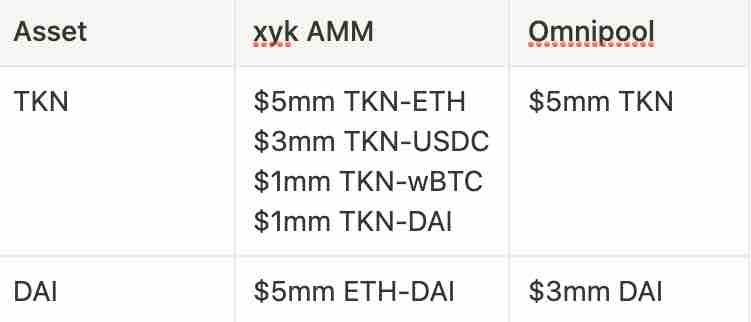
To illustrate this with an example, imagine that the TKN asset is spread across four different liquidity pools with different levels of liquidity. In the scenario that a trader wants to trade DAI against TKN, they would only have access to the direct liquidity of the $1M TKN-DAI pool. If their trade size is significant (e.g. $100,000+), the majority of trades are likely to be routed through a DAI ETH pool, followed by the TKN ETH pool in the traditional XYK landscape.
However, with the Omnipool, the same $5M (50% of the total $10M TVL) of TKN assets and $3M of DAI would be concentrated in one pool. So, if a trader executes the same trade on the HydraDX Omnipool, he will fully benefit from the $5M TKN liquidity and $3M DAI liquidity in his direct swap, thereby amplifying the impact significantly reduce the overall price.
Learn Crypto Trading, Yield Farms, Income strategies and more at CrytoAnswers
https://nov.link/cryptoanswers
Comments are closed.