
Emerging Threats to Financial Stability – New Challenges for the Next Decade | Speeches


Watch video: Speech by Bradley Jones, Assistant Governor Financial Systems, AFIA Conference, Sydney 31 October
Introduction
May you live in interesting times is a sardonic curse with uncertain origin.
Similarly uncertain is what the next decade might have in store for policymakers and participants in the
financial system – what new risks and opportunities might emerge, what their impact might be and
how they might interact. In the spirit of todays conference, I will step back from the conjunctural
outlook to discuss some of the emerging challenges to global and domestic financial stability that could
be with us for many years.
To spare any suspense, I have two punchlines.
First, the nature of the emerging risks we are likely to confront over the next decade have a different
complexion to those of recent decades (Table 1). Some of these risks could originate from
within the financial system, such as the risk of rapid-fire deposit runs in the digital age,
spillovers from entities that (individually) are not systemically important and higher interest rate
volatility. Importantly, other emerging risks are emanating from outside the system –
geopolitics, operational risk and climate change – and for which there is no historical precedent
to guide us.

If we are entering a decade laden with new types of risks, some of which could interact, the second main
message is that we need to rethink the concept of resilience. Its entirely possible, even likely,
that regulation and supervision will need to adapt as the threat environment evolves. But the ultimate
responsibility here lies with industry. There are limits to what even the most finely calibrated
regulatory and supervisory regime can achieve when industry governance and risk management practices fall
short. We have a shared interest in getting our collective response right.
Inside risk #1 – Rapid bank deposit runs in the digital age
Bank deposit runs are as old as banking itself. This is an artefact of liquid deposits funding less-liquid
assets, like loans. Much ink was spilled in the aftermath of the global financial crisis (GFC) to reduce
this inherent vulnerability, but international events over the past year suggest there is more work to
do.
Concerns over profitability and poor risk management have long been the catalyst for deposit runs. In this
sense, the banking turmoil in the United States and Switzerland earlier this year was no different. What
was unprecedented was the speed of deposit runs in affected banks (Graph 1). As a case
in point, Silicon Valley Bank (SVB) lost 30 per cent of its deposit base in a matter of hours,
with a further 50 per cent poised to be withdrawn the following day. In our
current system, any bank would struggle to survive a run of this magnitude. It was
far beyond the provisioning required under Basel III, and more severe than the fastest runs
experienced during the GFC.
Graph 1
So why was this time different? My reading is the answer lay with the interaction of new technology and a
different set of balance sheet vulnerabilities to those prevailing in the GFC.
Herding effects associated with social media present a new challenge for financial regulators. And it is
clearly easier to withdraw deposits at the stroke of a keyboard than it is to stand for hours in the rain
outside a bank branch and bury cash in the yard. But I see the role of technology here more as an
amplification mechanism, not a root cause.
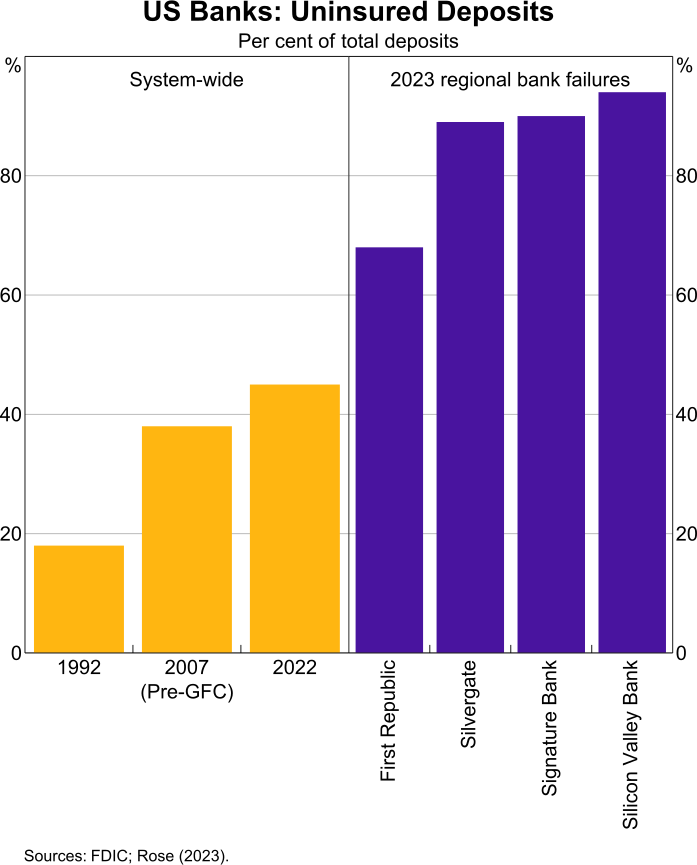
The share of deposits that were uninsured had been steadily rising in the US banking system, to the
highest level since 1947. For the three banks that failed in March, however, the share of uninsured
deposits was more than double the system-wide average, at 89–94 per cent for SVB, Silvergate and Signature Bank
(Graph 2). This might not have been an issue had these
uninsured deposits been widely distributed among unconnected parties. The problem was they were
concentrated in a small number of hands that were tightly connected via social media and industry
linkages. More than half of SVBs deposit base was sourced from companies in the technology and life
sciences sectors backed by venture capital firms that were exposed to the same macro shock (i.e. higher
interest rates lowering valuations), and key account holders were closely connected in social
networks. Similarly, crypto-asset clients accounted for almost
90 per cent of the deposits of Silvergate Bank, almost all of which were uninsured and exposed
to the same risk – a crypto-winter induced by higher interest rates. The
10 largest depositors at Silvergate accounted for almost half of its deposit base. And
part of the fear that spread through corporate deposit holders in the failed banks was not just related
to the safety of their deposits, but also access to them – businesses needed to make payroll and
other time-sensitive obligations.
Meanwhile in the case of Credit Suisse, key indicators of liquidity risk introduced under Basel III failed
to signal impending trouble ahead of its deposit run. This dog didnt bark, a point that is also
prompting reflection among policymakers.
Graph 2
These events raise no shortage of policy issues:
- How should deposit flight assumptions be recalibrated for the digital age?
- How should interaction effects between uninsured deposits and concentrated deposit bases be accounted
for? - Should all banks be required to mark-to-market their liquid asset buffers?
- Should deposit insurance caps be lifted when uninsured deposits are held by so few depositors, and
what would be the moral hazard implications? - How best can continuous access to deposits be enabled in banks experiencing severe stress?
- If banks choose to fund themselves with a high proportion of uninsured deposits, should they be
required to pre-position collateral at the central bank so they are better placed to handle runs of
any size?
It is impossible to do justice to these questions here, other than to say that they are animating
discussions among policymakers everywhere.
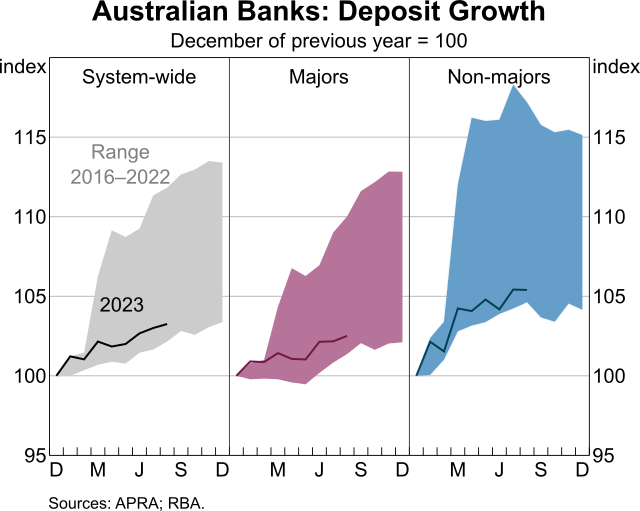
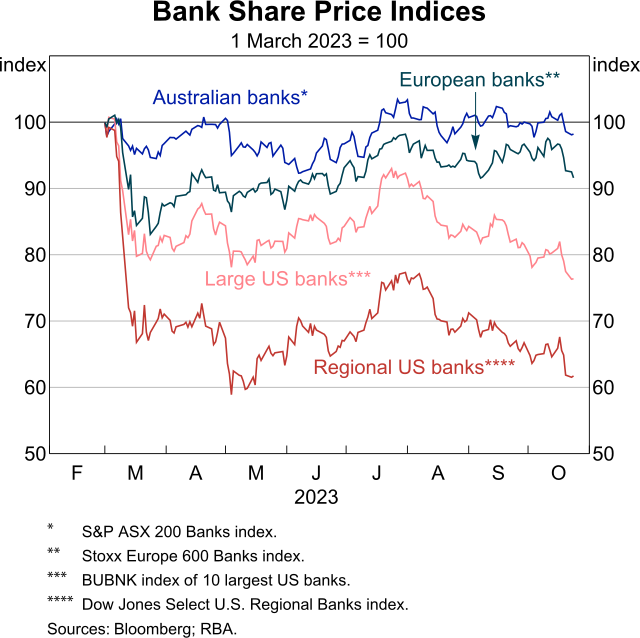
Before moving on, I should note that the Australian banking system did not experience the types of
stresses observed elsewhere (Graph 3; Graph 4). As the APRA Chair recently observed, we
dont have the same level of concentration risk or uninsured deposits in the deposit bases of key
Australian banks, and our liquidity and capital requirements are more onerous. That
said, there is no sense of complacency here – our colleagues at APRA will soon be consulting on
options for strengthening liquidity and interest rate risk management requirements.
Graph 3
Graph 4
Inside risk #2 – Systemic risks arising from entities that individually are not systemically
important
Rapid-fire deposit runs are arguably a special case of a broader vulnerability where systemic risks arise
from entities that, in the normal course, are not systemically important themselves. This means contagion
risk is taking on a new, more challenging complexion.
In asking whats different now?, my sense is that two amplification mechanisms have been
dialled up:
- the speed of money and information flows, which can magnify herding effects
- procyclicality in parts of the international asset management industry that have grown strongly.
First, money can now flow out of institutions and markets with unprecedented speed in response to the
rapid spread of information and misinformation, including that amplified through social media. In normal
times, fewer frictions in the flow of money and information should lead to better economic outcomes
– few advocate for the frictions and stale information of yesteryear. But the issue is more complex
in periods of heightened stress. As noted by the Financial Stability Board in its recent review, the
ubiquity of social media, combined with 24/7 access to banking and
payment services and more globally connected trading platforms, raises the possibility that a shock
somewhere in the financial system metastasizes into a broader self-fulfilling crisis of confidence.
In banking, concerns about rapid-fire outflows enabled by technology have been building ever since the
crisis at Continental Illinois in 1984, which was an early adopter of the systems that enabled its large
corporate clients to engage in rapid cash transfers inside and outside the United States.
Since then, money has moved within and across borders with increasing velocity. And in recent years,
social media has emerged as a new enabler of herding behaviour, including when depositors are in close
contact. Researchers have linked the unusual spike in social media activity not only to the rapid fall of
regional US banks in March, but to the stress experienced by other banks. In
Europe, Credit Suisse was immediately caught in the cross-fire, having only narrowly survived a deposit
run in October 2022 around the time a journalist tweeted that a major investment bank was on the
brink; this post had more than 6,000 retweets in less than 24 hours, a time when Credit
Suisse was losing CHF12–15 billion per day in deposits.
Likewise, rumours about the imminent collapse of Deutsche Bank in March saw its credit spreads trade
wider than during the peaks of the GFC and the European debt crisis, despite its revenues and
profitability having recently hit a multi-year high.
Institutions that might have little direct connection to the original source of stress, but are perceived
to have broadly similar business models, seem particularly vulnerable in an environment of shoot
first, ask questions later – especially when the shooting can happen faster than
ever.
A different amplification mechanism relates to procyclicality in parts of the fast-growing international
asset management industry. As they dont accept deposits, investment funds operate with less
intensive regulation and oversight of their liquidity management and use of leverage compared with banks.
Nor do they benefit from public backstops that can dampen liquidity stress, such as central bank
liquidity access or deposit insurance. Herding effects can also be amplified when funds are tied to
similar benchmarks. Where they offer redemption terms to investors that cannot be easily met in stressed
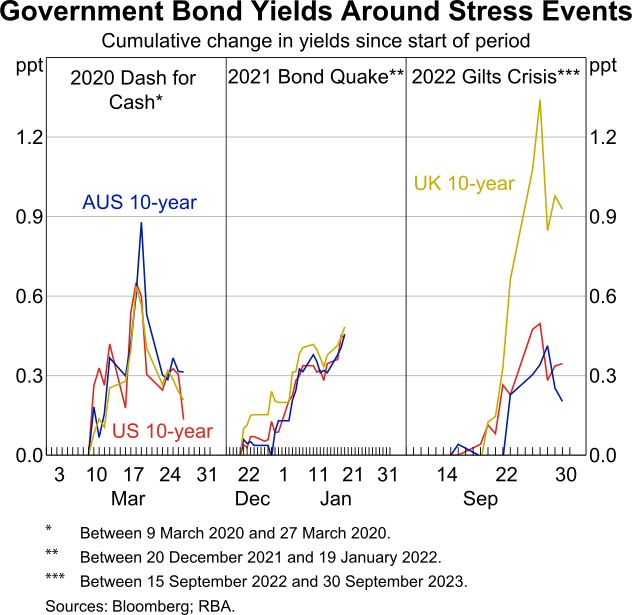
market conditions, asset fire sales can result. The periods of market dysfunction in key bond markets in
early 2020 and 2021 were associated with this dynamic and saw a number of central banks respond. The use
of leverage can be an accelerant of these illiquidity spirals. This was evident in the gilt
market meltdown of September 2022, when an initial increase in yields set off a self-reinforcing cycle of
asset sales by pension funds and required intervention by the Bank of England to restore market
functioning. While the make-up of the Australian financial system
means we are not as directly exposed to these fire sale dynamics, our funding markets have been
significantly disrupted by international events (Graph 5).
The wider spillovers amplified by small banks and investment funds in recent times raises a variety of
issues. One is whether the bar for banks to be designated as systemic should be lowered. Another is how
far regulators should go in imposing more onerous obligations on smaller banks, recognising that
proportionality is central to regulatory design and that a regime that is unduly onerous could curtail
the sort of competition and innovation that would otherwise benefit society. A more general issue is how
resilience and recovery planning should better account for increased contagion risk. And in the case of
investment funds, an ongoing issue is how they can continue to play an important role in intermediating
savings while minimising the liquidity risks that can severely destabilise the functioning of critical
financial markets. All of these issues are now under active international review.
Graph 5
Inside risk #3 – Structurally higher interest rate volatility
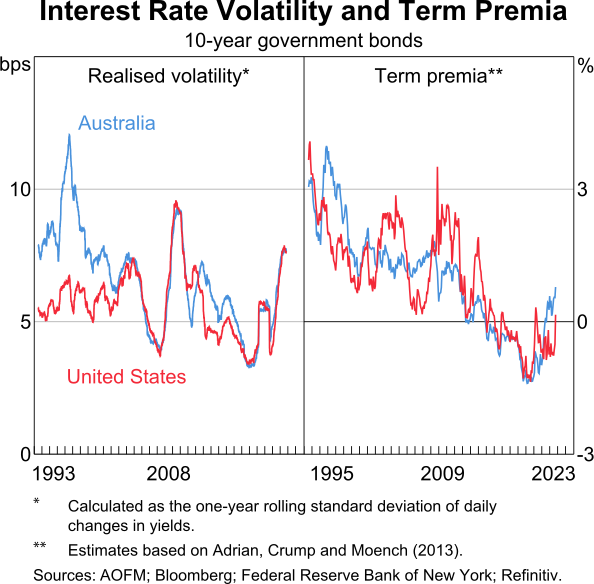
Much of the prior two decades saw long-term interest rate volatility either decline or languish at
unusually subdued levels (Graph 6, left panel). There are, however, a number of factors that, in the
years ahead, could contribute to a regime shift characterized by structurally higher interest rate
volatility:
- The great moderation is behind us. The global economy now appears more vulnerable to
stagflationary supply shocks, including from the rewiring of globalisation, geopolitical and
political economy tensions, and energy shocks from climate change (and related policies). This
contrasts with recent decades, where developments on the supply side of the economy were typically
favourable for growth and inflation and so dampened financial market volatility. - A higher and more volatile bond term premium. For the better part of
three decades, the term premium on bonds declined relentlessly (Graph 6, right panel). This
reflected factors that are unlikely to continue, including declining uncertainty over future
inflation outcomes and real policy rates, coupled with structural supply–demand imbalances in bonds that meant governments were able to
issue debt with little or even negative term premia. - Reduced smoothing from price-insensitive buyers. To varying degrees over the past two
decades, volatility in key bond markets has been supressed by the bid from foreign exchange (FX)
reserve managers and domestic asset purchase programs by central banks. Again, this era now seems
behind us. In recent years, reserve managers have become net sellers of US Treasuries and, on current
plans at least, central banks will be reducing their domestic bond holdings for years to come. This
is occurring against a backdrop where broker-dealers have reduced ability and willingness to bid for
bonds during periods of heightened volatility.
Graph 6
A period of structurally higher interest rate volatility would present challenges to financial system
stability, a few of which I will mention here:
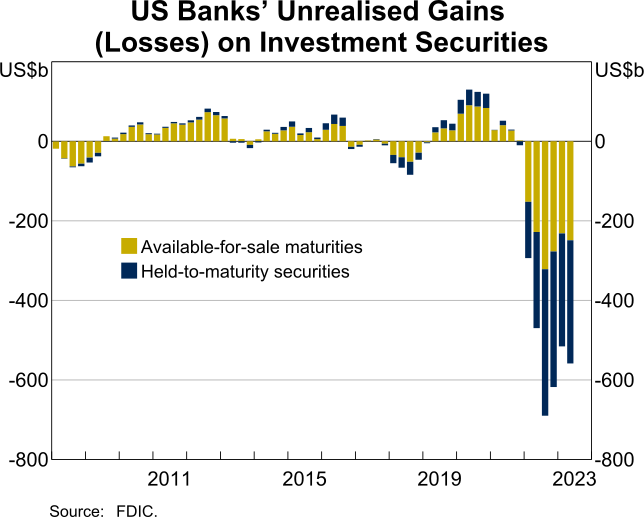
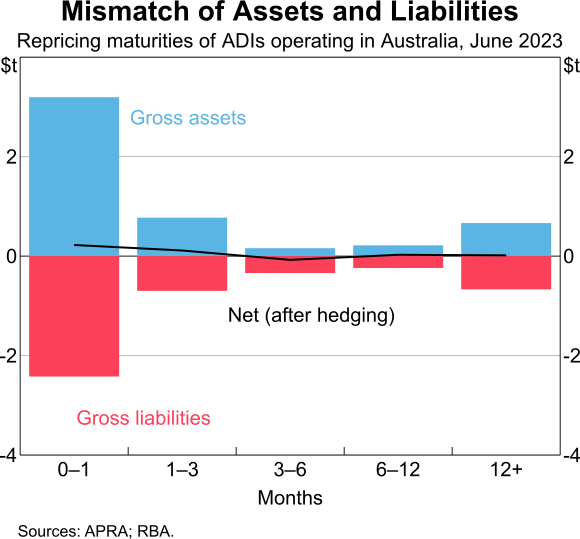
- Bank duration risk. Banks of all sizes will have to manage overall duration risk more
intently. Inadequate management of interest rate risk was an important contributor to the US banking
stresses in March (Graph 7). In Australia, banks tend to have modest exposure to securities
compared with their peers, large banks are required to hold capital for interest rate risk in the
banking book, and residual interest rate risk tends to be hedged (Graph 8). Nevertheless, this
is an area of ongoing supervisory focus in many jurisdictions. - The interaction of interest rate and credit risk. Over much of the past few decades,
growth in incomes consistently exceeded the level of interest rates (g> r). This
dampened credit risks for lenders. But debt servicing among borrowers with high debt levels will be
more challenging – and credit risks will increase as a result – in an environment where
interest rates periodically exceed the growth in incomes. - Financial market functioning. The post-GFC era of exceptionally low interest rate
volatility gave rise to a new generation of investment business models and strategies. This includes
strategies that: (i) involve the procyclical leveraging up of bond positions when volatility
dips; and (ii) assume a negative correlation between
bond and equity returns (as tends to occur in low and stable inflation regimes). It remains to be
seen how market functioning could be affected in a regime of higher inflation and interest rate
volatility, including where open-end fixed-income funds encounter liquidity stress, margining is more
tightly enforced than in the past, and broker-dealers are unable or unwilling to
supply liquidity.
Graph 7
Graph 8
Outside risk #1 – Geopolitical risk
War may well be the father of all things, as the philosopher Heraclitus once observed. Since
1945, however, the absence of direct conflict between economically integrated powers meant two
generations of economic policymakers and industry participants could turn their attention elsewhere. But
recent events suggest this is no longer tenable. For a start, geoeconomic fragmentation will render the
global economy more prone to supply shocks. The International Monetary Fund (IMF) has estimated it could
result in global output losses of up to 7 per cent, rising to 12 per cent for some
countries. And as a more strained geopolitical environment
could also have material implications for financial stability – not limited to the cross-border
allocation of capital, international payment systems, key financial institutions, and global funding and
commodity markets – a considerable body of work is now emerging internationally to determine where
financial resilience needs to be bolstered.
As an organising framework, I find it useful to decipher the related risks to financial stability along
two dimensions: slow-burn fragmentation, and fast-burn kinetic risk.
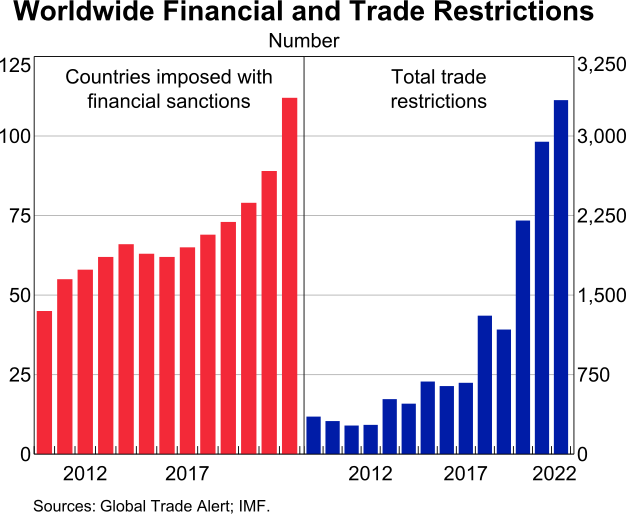
Slow-burn fragmentation is arguably no longer a risk – it is already underway. Trade and financial
sanctions (including counter-sanctions) were increasing even prior to the Russian invasion of Ukraine
(Graph 9). Just in time efficiency is being traded off for strategic resilience in
supply chains. Alternative payment messaging systems are being developed, and FX reserves are being
shifted to countries and assets deemed less vulnerable to seizure. A smaller share of foreign
direct investment, portfolio investment and bank credit is flowing between countries that are less
aligned on foreign policy issues (Graph 10). It is now common to hear some countries characterised
as uninvestable in a way that was not the case just a few years ago. And fraying support for
international cooperation risks hampering operation of the global financial safety net.
Graph 9
Graph 10
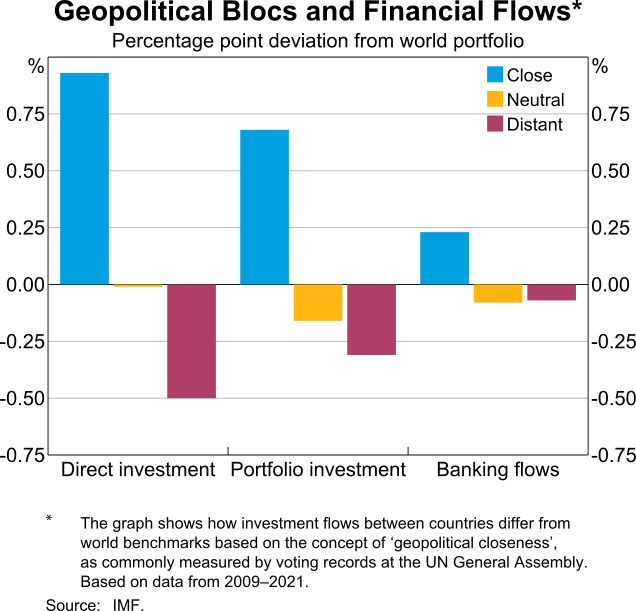
The second (and even more troubling) dimension is fast-burn kinetic risk – the risk that tensions
escalate into conflict among countries critical to the global economy. Global financial stability risks
increase along a continuum in this respect, depending on the scale, location and countries involved.
Events over the past two years give a sense as to the underlying stress transmission channels. Global
shipping could become prohibitively costly or uninsurable along certain routes. Global financial
conditions could tighten abruptly, with key funding markets, risk asset prices and cross-border lending
severely affected. Cross-border assets could be frozen or seized. Payment systems and financial market
infrastructures could be affected by sanctions and counter-sanctions. Cyber-attacks on key institutions
could become more prominent. Disruptions to global commodity markets would be most significant where
global production is concentrated in a small number of countries and where key trade routes are
affected. More generally, the longer any conflagration
persisted, the stronger the feedback loop between real and financial channels, including deteriorating
asset quality for banks.
The policy implications and trade-offs associated with heightened geopolitical risk are daunting and
complex, so I will simply note here the importance of building financial and operational resilience along
various dimensions – at both the domestic and international level. At the international level, one
key concern is to prevent the global financial safety net from splintering into smaller liquidity pools
based on geopolitical blocs. As the IMF has noted, a danger here is that the substantial benefits that
come with international risk sharing are compromised at a time when the call on international resources
could increase substantially.
Outside risk #2 – Operational risk
The increasing digitalisation of financial services has been a key source of innovation. But it also means
operational risk is now a first order enterprise-wide risk that demands the highest standards of
management and governance. As some operational risks could also have systemic implications, this is
emerging as a key regulatory priority the world over.
I will focus here on three risks, the most immediate and challenging of which is cyber. The scope for, and
consequences of, cyber-attacks continue to increase. Challenges are building from third-party technology
dependencies, geopolitical tensions and resourcing constraints among smaller institutions that could be
key points of vulnerability for the wider system. Attacks can result in direct financial losses (from
theft and ransoms) and indirect losses arising from reputational damage. The past year alone has borne
this out in Australia and elsewhere.
A multi-faceted policy response is rolling out in response. In Australia, the Government established the
role of National Cyber Security Coordinator in May 2023 to coordinate and strengthen cybersecurity
policy, preparedness and response capability. APRA has recently conducted a cybersecurity stocktake and
finalised a new broader operational risk standard for its regulated entities, which will incorporate
stronger requirements for maintaining and testing internal controls, improved business continuity
planning and enhancing institutions oversight of external service providers.
Regulators are also signifying a clear intent to undertake enforcement actions where firms fail to meet
expected standards of conduct. And the Cyber Operational Resilience Intelligence-led Exercises Framework,
developed by the Council of Financial Regulators (CFR) and led by the Reserve Bank, continues to test the
resilience of key financial institutions to cyber-attacks. All that said, this is an area where no amount
of supervisory focus can substitute for robust planning and preparedness by financial institutions.
A second operational risk relates to critical technology service providers that have been largely
operating outside the financial regulatory perimeter. Banks and financial market infrastructures are
considering moving some services to the cloud, and for sound reasons. But exposure is concentrated in a select number of service providers
and an outage could leave many institutions unable to perform critical functions. Concerns
about governance, risk management, platform concentration risk and responsiveness in a crisis have also
been raised in respect to the use of emerging technologies by financial institutions, such as distributed
ledgers. And in some jurisdictions, Australia included, BigTech has sought to move into payment services
(including through digital wallets) without the regulatory oversight typically imposed on other financial
service providers.
A third operational risk – artificial intelligence (AI) – seems more distant but no less
challenging. AI offers enormous opportunities for the financial system and wider economy, but managing
the associated risks will not be straightforward. As Gary Gensler (Chair of the US Securities Exchange
Commission) has noted for some time, the financial stability risks relate to the potential for shocks in
the financial system to be magnified. Contagion and herding risk is one potential channel,
where parties could come to rely on similar models and data aggregators that are trained on similar data
and so generate similar actions – including in a crisis. And because the underlying models are
complex and typically developed outside of the financial regulatory perimeter, system-wide
vulnerabilities could be brewing in a way that is not obvious to financial institutions or supervisors.
Outside risk #3 – Climate change
Risks to financial stability resulting from climate change and related policies will be with us for years
to come. Physical risks from more extreme weather patterns and higher average temperatures can reduce the
value of assets and income streams in sectors and parts of the country. Transition risks, including
unexpected changes to regulations and consumer preferences, can also lower the value of assets or
businesses in emissions-intensive industries. These risks can result in unexpected losses for lenders,
increased claims on insurers and write-downs for investors – as we are now observing.
Internationally, direct exposures to emissions-intensive businesses are largest for investment funds,
followed by insurers, and then banks.
As the Bank has previously set out the financial stability implications in Australia from climate change,
I will briefly recap our main takeaways to date. The Bank and APRA have applied complementary
approaches to examining the possible effects of physical and transition risks for the Australian banking
system. This preliminary analysis has found that banks would
experience losses under different scenarios but not of a magnitude that would cause significant stress,
as lending losses appear concentrated in specific regions and industries that represent a small
proportion of banks overall assets. Nevertheless, these early results need to be treated with
caution as our understanding of climate-related risks to the financial system is still developing; losses
could be larger and occur faster than currently anticipated. More advanced modelling techniques and more
granular data are needed to produce more robust estimates of possible credit losses.
A particular domestic focus in the period ahead will be the household insurance sector. Payouts have been
rising in real terms for some time, and more frequent and severe weather events are expected to further
increase claims on damaged property and other assets. Insurers have the ability to reset insurance
premiums quickly to recoup climate-related losses, or they could withdraw coverage from high-risk
regions. This would pass risk back to households, businesses and governments, or to the lenders in the
case of loan defaults where affected assets are used as collateral. To better understand the risks to the
financial system and broader community that could occur due to changes in the cost and coverage of
insurance, APRA, on behalf of the CFR, will soon conduct a climate scenario analysis with insurers. More
broadly, the Bank, in conjunction with other CFR agencies, is coordinating on a set of priorities to
support industry participants to manage their climate-related risks and opportunities.
Concluding remarks
There are two common threads to the themes I have discussed today.
The first is that there are a number of emerging risks to financial stability that look quite different to
those of recent decades and that will likely be with us for some time. Some have no historical precedent,
and could interact, and so will require particularly careful attention. Governance and risk management
practices that have a strong forward-looking orientation will have a central role here – think more
scenario analysis and reverse stress testing, and less historical backtesting.
The second is that building resilience along various dimensions will be critical, recognising of course
that there are always trade-offs to be managed. Strengthened resilience was the north star for the
reforms for large global and domestic banks following the GFC. But for the financial system at large,
there is more to do here. We cant know which risks will be realised or when. But we can be better
prepared for whatever might come our way.
Learn Crypto Trading, Yield Farms, Income strategies and more at CrytoAnswers
https://nov.link/cryptoanswers
Comments are closed.