


Before opening the Osmosis AMM app, make sure you install the Keplr wallet.
Open the app
Go to https://app.osmosis.zone/
Connect Wallet
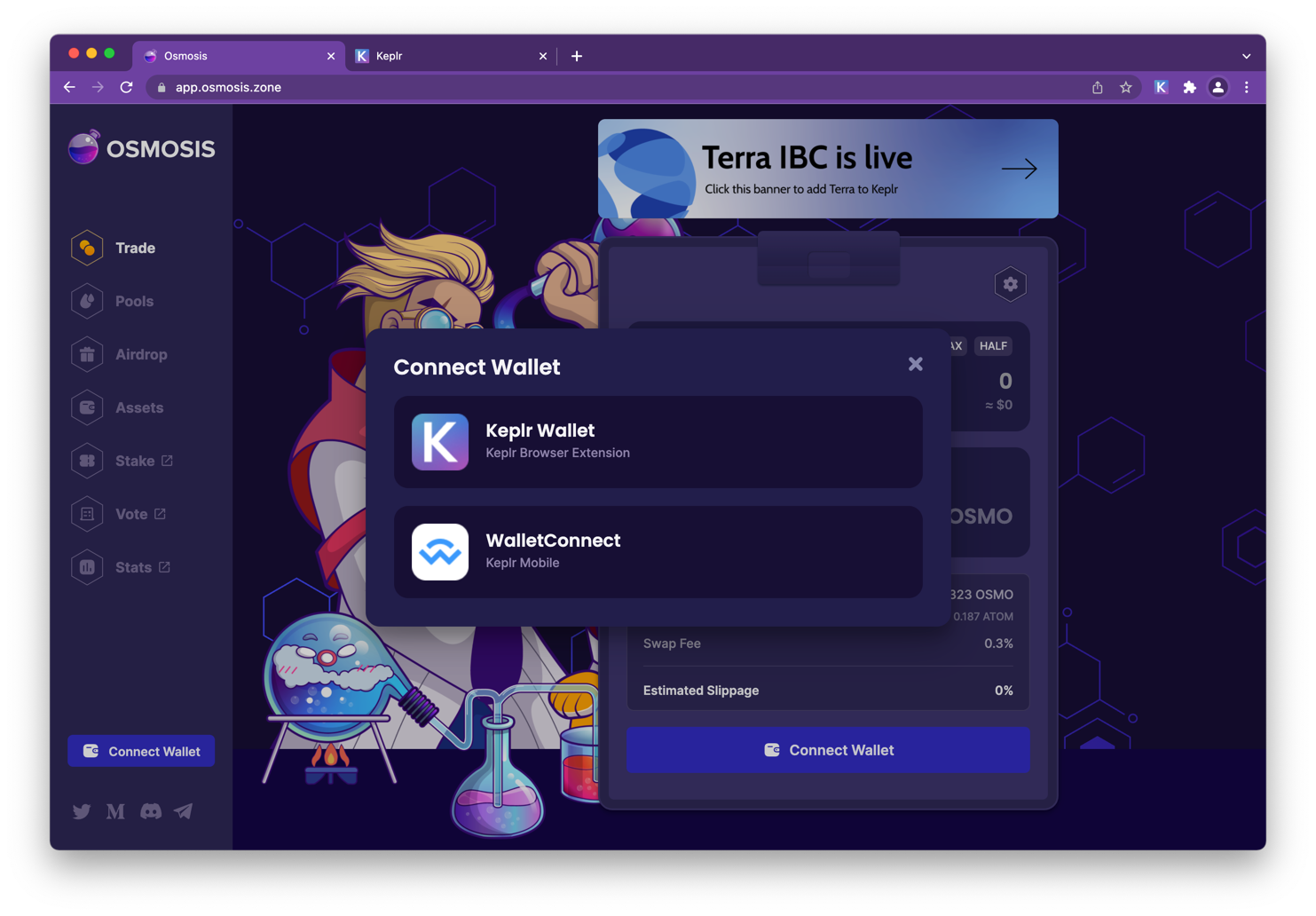
Click Approve. This confirms that you are connecting to the app.osmosis.zone and the osmosis-1 chain.
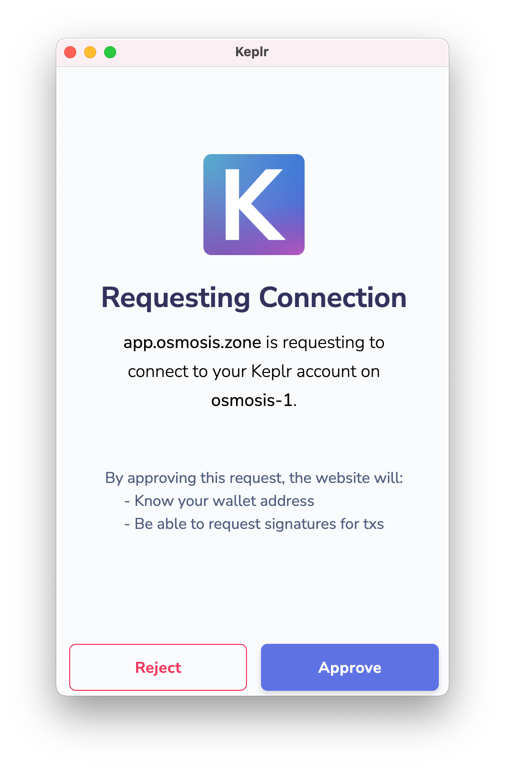
::: Danger Always make sure you are connected to the app.osmosis.zone (osmosis-1) name and network :::
Deposit money
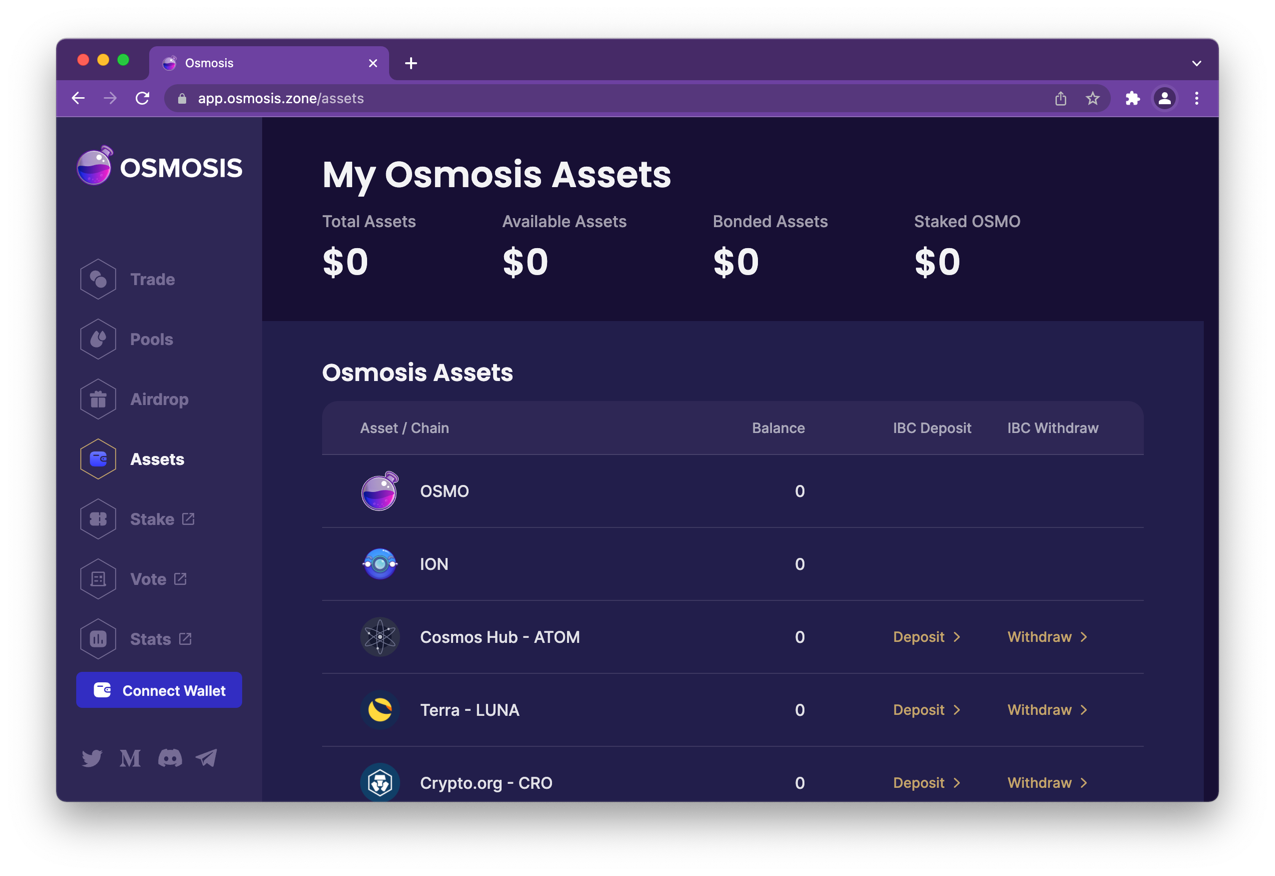
Click Assets. Then click on the deposit link next to the asset name. In this example we will click on the ATOM deposit link.
Accept the connection to Cosmoshub-4
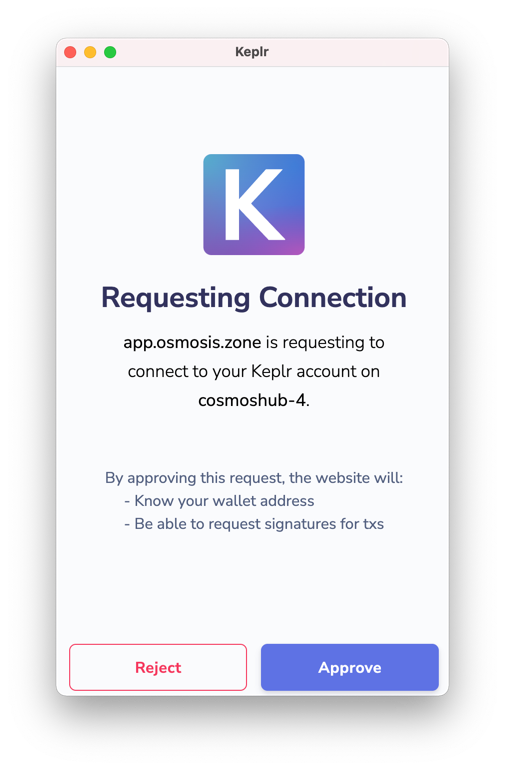
Once connected, select how much you want to deposit and then click the “Deposit” button.
Approve the transaction
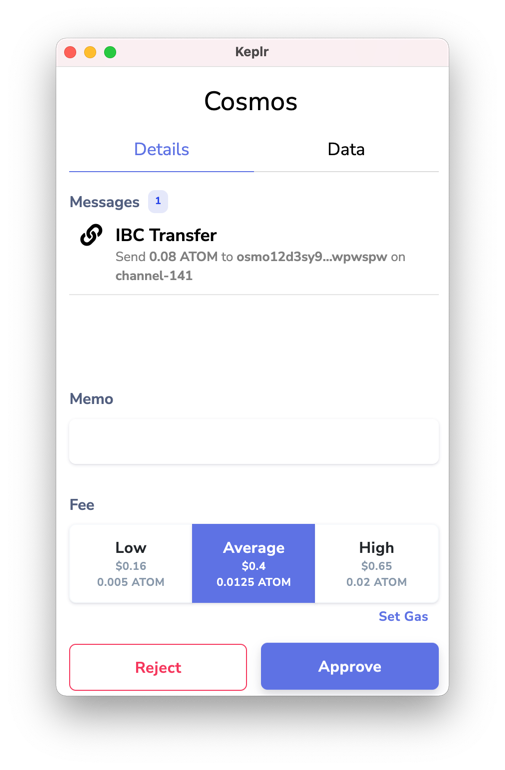
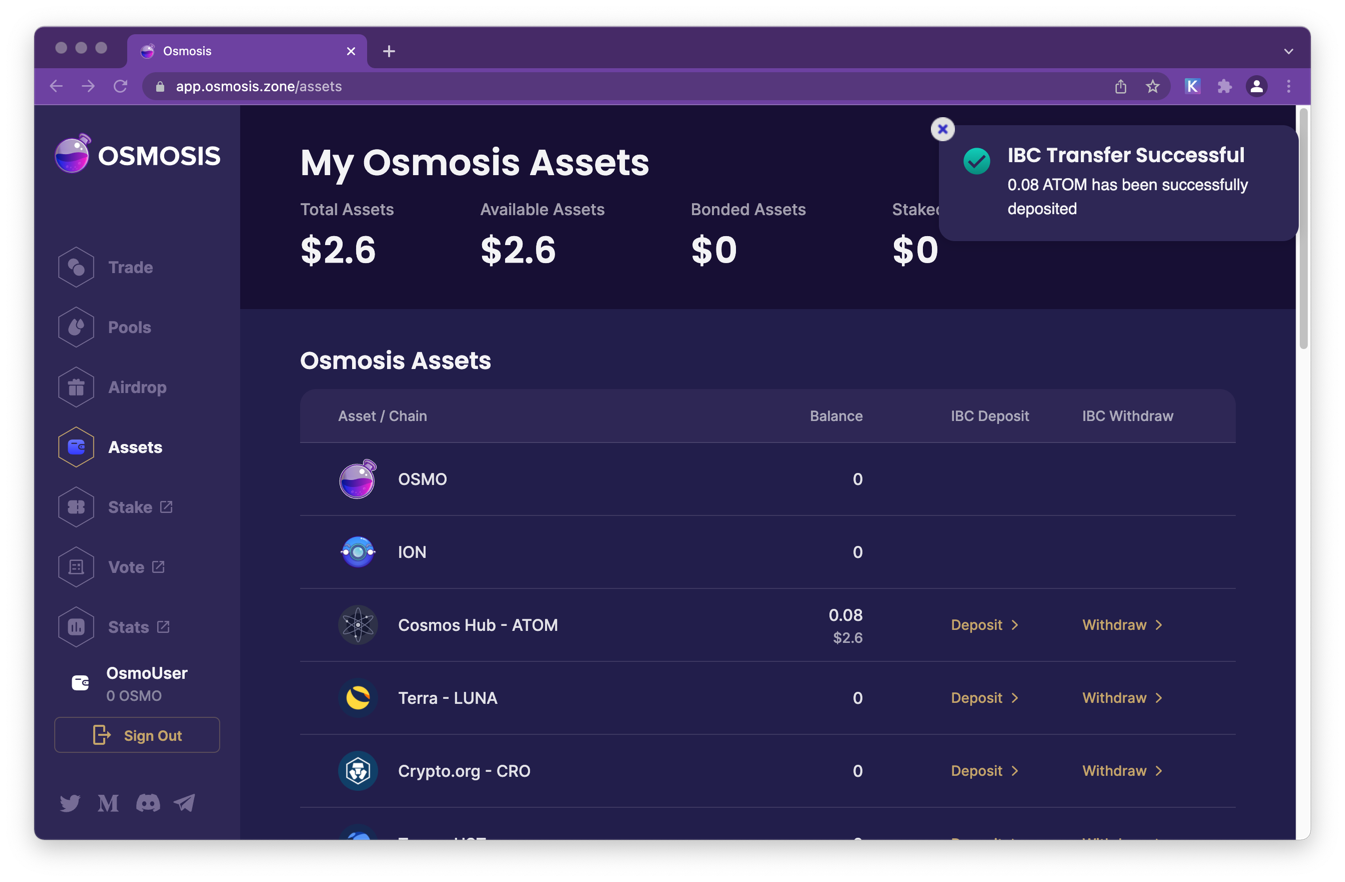
Once the transaction is completed, a series of confirmation notifications including the IBC confirmation will be displayed.
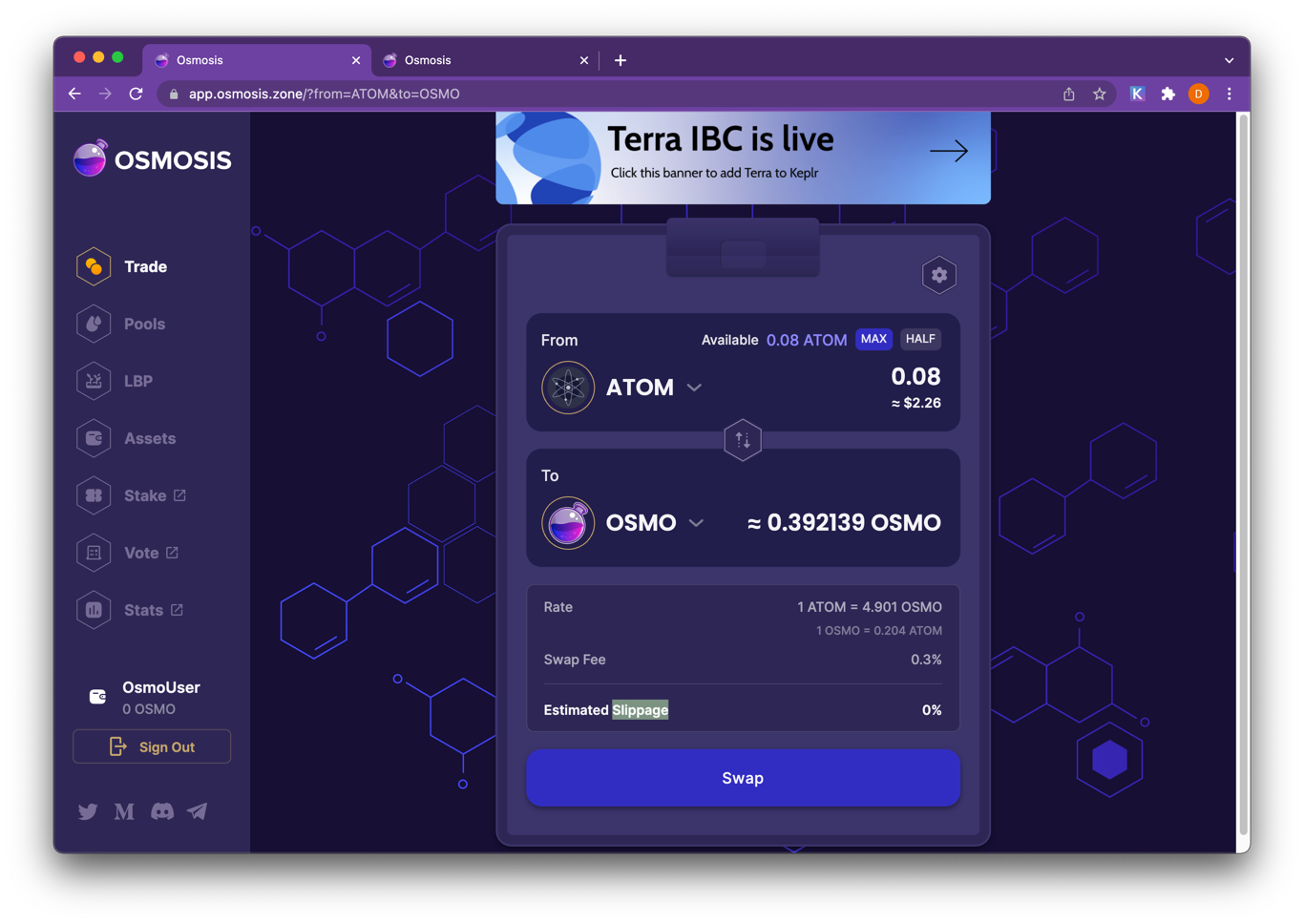
exchange tokens
Trading tokens is as simple as clicking the ‘Trade’ link and then selecting the pair you wish to trade. Check out the glossary to learn more about terms like slipage.
On the Pools page, select a pool.
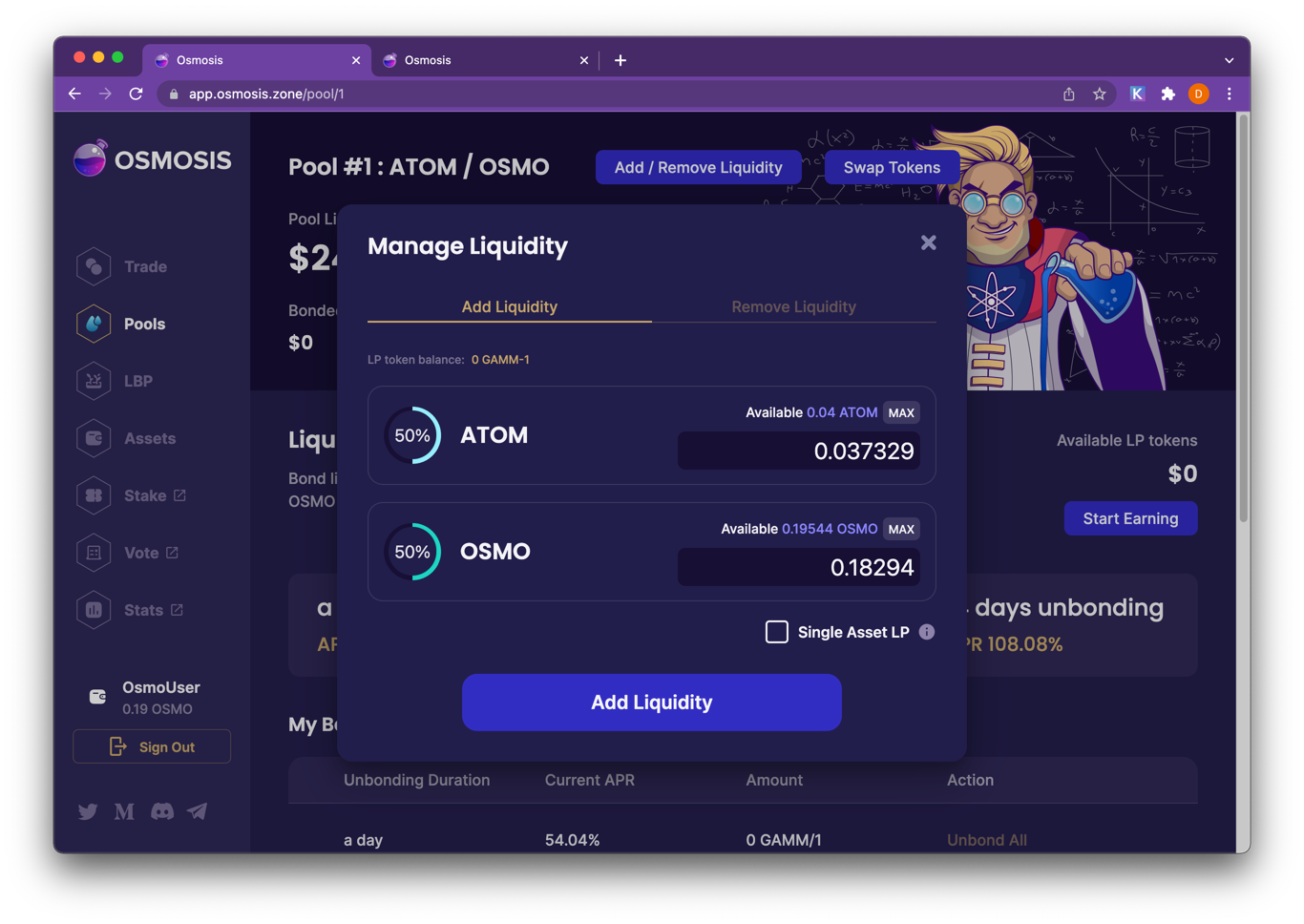
Then click Add/Remove Liquidity
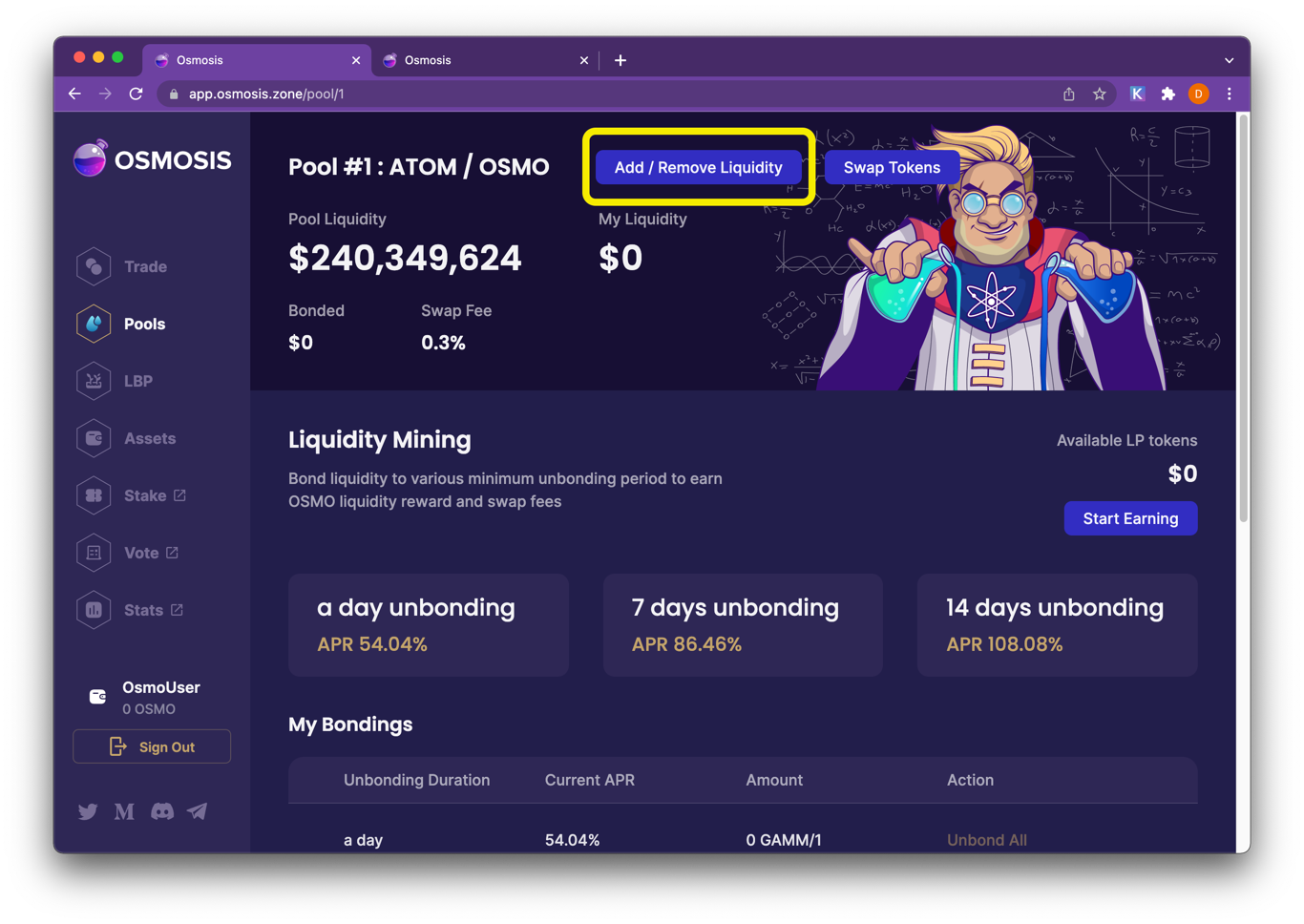
Enter a quantity of one of the assets. The amount of the other assets will be completed automatically. (Pools require assets to be deposited at predetermined weights.)
Please note that just adding liquidity will not give you any reward. In order to get rewards, you must bind LP tokens.
To withdraw liquidity, enter the percentage to be withdrawn.
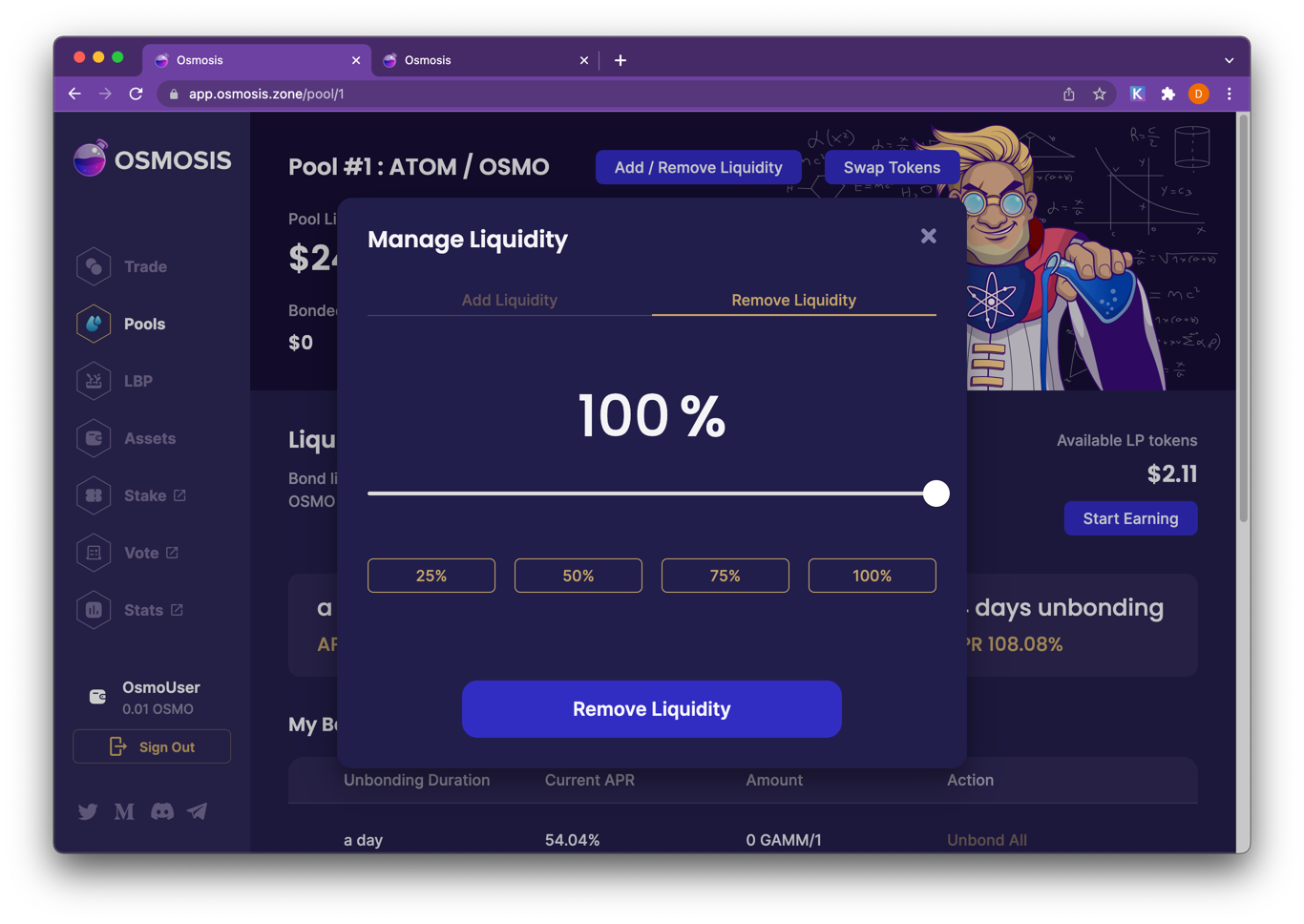
Incentive pools receive OSMO liquidity mining rewards. Rewards are distributed to bound LP tokens in these pools that meet the bind length criteria.
Binding of LP tokens
Start earning! Users can pledge their LP tokens after depositing liquidity. LP tokens remain bound for the duration of their choice. Linked LP tokens are eligible for liquidity mining rewards if they meet the minimum binding length requirement.
Click Start Earning and select a retention period.
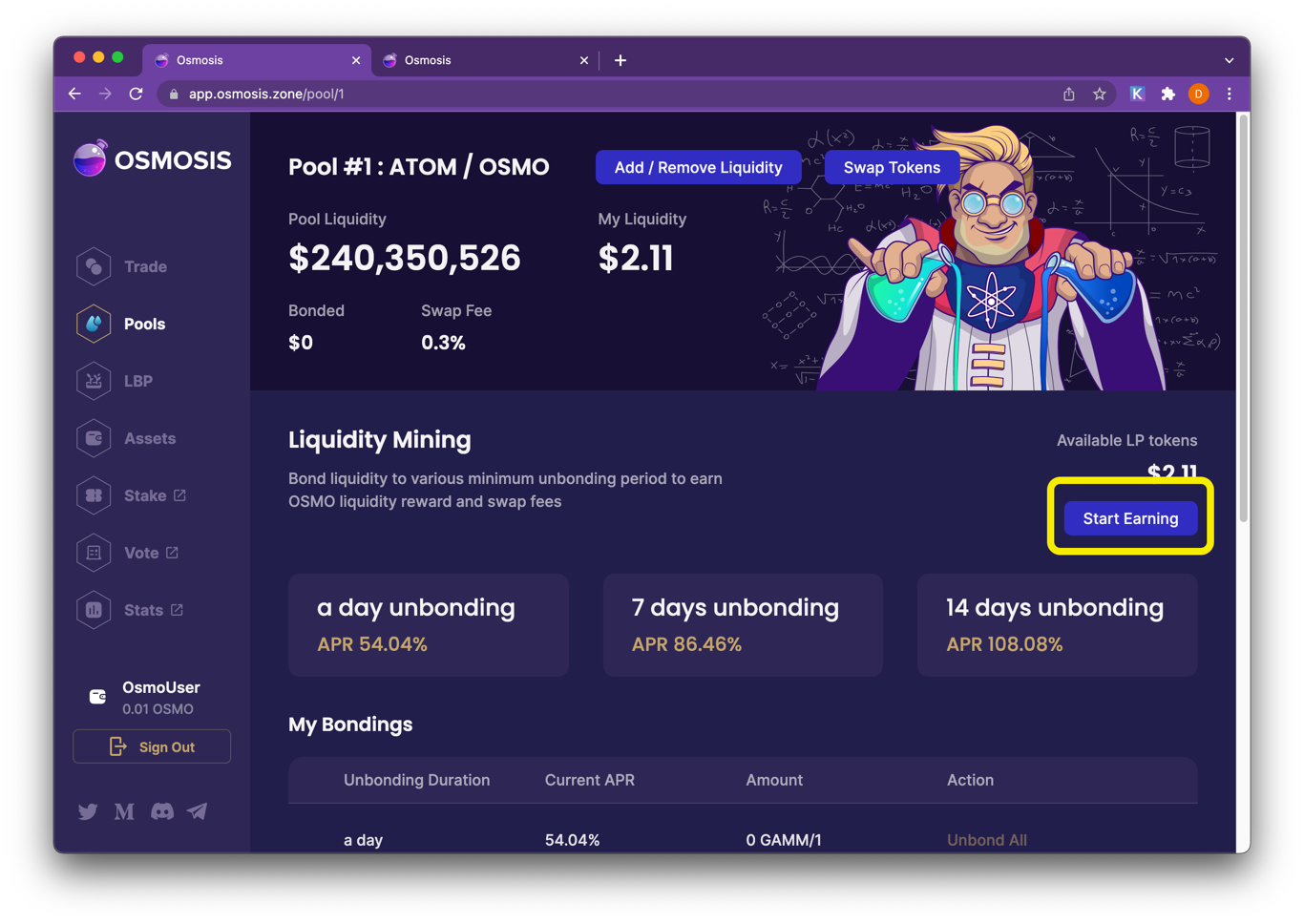
When a user wants to unbind an LP token, they submit a transaction that starts the unbinding period. After the timer expires, they can submit another transaction to withdraw the tokens.
Create a new pool
Creating pools in Osmosis is permission-free, meaning any user can create a pool with two or more supported assets. Go to Pools > Create Pool. From your wallet, select the assets that will make up the pool. Choose a weight for each asset.

Select an amount of each asset to contribute to the pool.
Enter a swap fee for the pool. (An explanation of swap fees can be found here.)
Click “Create Pool” and voila! The pool will be opened. The parameters chosen when creating the pool (token weights, swap fees) cannot be changed later.
Liquidity bootstrapping pools
Osmosis provides a convenient design for Liquidity Bootstrapping Pools (LBPs), a special type of AMM designed for token selling. New protocols can leverage Osmosis’ LBP feature to distribute tokens and achieve initial pricing.
LBPs differ from other liquidity pools in terms of the ratio of assets within the pool. With LBPs, the ratio adjusts over time. LBPs include an initial ratio, a target ratio, and a period over which the ratio adjusts. These weights are subject to change prior to launch. One can create an LBP with a starting ratio of 90-10, aiming to reach 50-50 within a month. The ratio continues to gradually adjust until the weights within the pool are equal. As with traditional LPs, the prices of assets in the pool are based on the ratio at the time of trade.
After the LBP period expires or the final ratio is reached, the pool will convert to a traditional LP pool.
LBPs facilitate price discovery by demonstrating an asset’s acceptable market price. Ideally, LBPs will have very few buyers at launch. The price slowly decreases until traders are ready to step in and buy the asset. Arbitrage maintains this price for the remainder of the LBP. The process is indicated by the blue line below. The price goes down when conditions adjust. Buyers step in until the acceptable price is reached again.

Choosing the right parameters is very important for pricing an LBP. If the initial price is too low, the asset will be bought out once the pool is launched. It is also possible that the target final price is too high and therefore there is little demand for the asset. The green line above shows this scenario. A buyer places a large order, but after that the price keeps dropping as no other buyer is willing to bite.
Osmosis aims to provide an intuitive, user-friendly LBP design to give the protocols the best chance of a successful sale. The LBP feature facilitates initial token pricing and allows protocols to fairly distribute tokens to project stakeholders.
Measures for tied liquidity
Bonded Liquidity Gauges are mechanisms for distributing liquidity incentives to LP tokens that have been tied for a minimum period of time. 45% of OSMO’s daily output goes into these liquidity incentives.
For example, a 1-week measure of Pool 1 LP stock would distribute rewards to users who committed Pool 1 LP tokens for a week or more. The amount each user receives is proportional to the number of their bound tokens.
A tied LP position can be suitable for several gauges. Qualification for an apprenticeship only requires a minimum bonding time.

Rewards generated by Liquidity Mining are not subject to unpegging. Rewards are liquid and immediately transferable. Only the main certificated shares are subject to the delisting period.
mapping points
Not all pools have incentive meters. At Osmosis, the participating OSMO holders decide which pools they want to promote through on-chain governance proposals. To incentivize a pool, governance can allocate “allocation points” to specific meters. At the end of each daily epoch, 45% of the newly released OSMO (the portion earmarked for liquidity incentives) is distributed proportionally to each gauge’s allocation points. The percentage of OSMO Liquidity Awards each meter receives is calculated as the number of its points divided by the total number of allocation points.
For example, let’s take a scenario where three gauges are promoted:
- Gauge #3 – 10 allocation points
- Gauge #4 – 5 allocation points
- Gauge #7 – 5 allocation points
In this scenario, a total of 20 allocation points are awarded. At the end of the daily epochs, meter #3 receives 50% (10 out of 20) of the minted liquidity incentive. Gauges #4 and #7 each receive 25%.
Governance can pass an UpdatePoolIncentives proposal to edit any meter’s existing allocation points. By setting a gauge’s assignment to zero, it can be completely removed from the list of funded gauges. Suggestions can also set the assignment points of new gauges. When a new gauge is added, the total number of allocation points increases, diluting any existing incentive gauges. Gauge #0 is a special gauge that sends its incentives directly to the chain community pool. By allocating allocation points to Gauge #0, governance can store some of the current liquidity mining incentives to spend at a later date.
At Genesis, the only benchmark that is encouraged is benchmark #0 (the community pool score). However, immediately after implementation, a governance proposal can be made to select which meters/pools to incentivize. The governance vote period is only three days at launch, allowing liquidity incentives to be activated as early as three days after creation.
External incentives
Osmosis not only allows the community to incentivize metering devices. Anyone can deposit tokens into a meter for distribution. This feature allows external parties to augment Osmosis’ own liquidity incentive program.
For example, there can be an ATOM< >FOOCOIN pool with a one-day meter encouraged by governance OSMO rewards. However, the Foo Foundation may also choose to add additional incentives to the one-day scale, or even add incentives to a new scale (such as a one-week scale).
These external incentive providers can also set up long-term incentive programs that spread rewards over a longer period of time. For example, the Foo Foundation can deposit 30,000 Foocoins distributed over a month-long liquidity program. The program automatically distributes 1000 Foocoins per day to the meter.
In addition to liquidity extraction, Osmosis offers three revenue streams: transaction fees, swap fees, and exit fees.
TX Fees
Transaction fees are paid by each user to post a transaction on the chain. The amount of the fee depends on the calculation and storage costs of the transaction. The minimum cost of gas is set by the applicant of a block in which the transaction is included. This transaction fee is distributed to OSMO stakers on the network. Validators can choose which assets are accepted in their proposed blocks for fees. This option is a unique feature of Osmosis.
Swap Fees
Swap fees are fees charged for performing a swap in an LP pool. The fee is paid by the trader in the form of the input asset. Pool creators set the swap fee when setting up the pool. The total fee for a given trade is calculated as a percentage of the swap size. Fees are added to the pool, effectively resulting in a prorated distribution to the LPs in proportion to their share of the total pool.
redemption fees
Osmosis LPs pay a small fee when removed from the pool. Similar to swap fees, exit fees per pool are set by the pool creator. Redemption fees are paid in LP tokens. Users withdraw their tokens, minus a percentage for the exit fee. These LP portions are burned, resulting in a proportional distribution to the remaining LPs.
Learn Crypto Trading, Yield Farms, Income strategies and more at CrytoAnswers
https://nov.link/cryptoanswers
Comments are closed.