
Investing in digital transformation: access to blockchain, crypto through stocks and more


ra2studio/iStock via Getty Images
Bitcoin, the first cryptocurrency, was invented in 2008 after the Great Recession pushed public opinion further away from the traditional banking system as investors demanded more transparency and efficiency. Bitcoin sparked the “decentralized finance” revolution that included the capability to conduct peer-to-peer transactions without an intermediary (e.g. a bank) and create a transparent, shared, immutable ledger, also known as a “blockchain”. Over the past 13 years, cryptocurrency has grown beyond a method of digital transaction as retail investors have learned to take advantage of large price swings in the price of cryptocurrencies. Eventually, as commerce evolved, cryptocurrency and blockchain evolved into a unique asset class that encompasses overarching themes of digitization, transparency, and investor participation. Instead of buying and selling Bitcoin and Ethereum directly, investors can now participate in the crypto market by investing in a range of options – futures, exchange-traded products, trusts, stocks of crypto miners, and stocks of companies that use cryptocurrency or blockchain operations.
The cryptocurrency market continues to grow
The global crypto market cap is $1.91 trillion as of August 17, 2021. There are over 11,000 different types of cryptoassets across 395 exchanges, although Bitcoin and Ethereum hold about 44% and 19% market share, respectively (cryptocurrency prices, charts, and market caps). | CoinMarketCap). As an investment, cryptocurrencies are somewhere between raw materials and currency. Like gold, crypto has a low correlation to traditional assets, although crypto also has the benefit of being easily transferrable around the world, making it a more practical and secure method of transaction. And although bitcoin is a type of currency, unlike the dollar, bitcoin is almost entirely demand-driven. Bitcoin has a maximum supply capped at 21 million (currently the circulating supply is nearly 18.8 million). On the other hand, the US Treasury is constantly printing dollars, while the Fed controls supply through policy. Because Bitcoin is largely demand-driven, investors have benefited from the use of technical analysis to capitalize on the wide swings in price that result from widespread media coverage and company news – impacting the price both positively and negatively.

Blockchain has applications outside of cryptocurrency
At a high level, blockchain is a shared, transparent record of transactions. Each transaction is considered a “block” that records specific data. Each block is connected to the others to form a chain of trusted transactions that cannot be tampered with (What is blockchain technology – IBM Blockchain | IBM). Although blockchain has traditionally been associated with cryptocurrencies, the technology has been adopted across multiple industries. For example, Nestle SA (OTCPK:NSRGY, NESN: SWX) was the first major food and beverage company to digitize its supply chain with an open blockchain so customers can track their purchases (e.g. milk from farms in New Zealand to factories in Track New Zealand). in the Middle East) (Nestlé breaks new ground with open blockchain pilot | Nestlé Global). And Bank of America (BAC) recently joined Paxos Trust Co.’s blockchain network to further develop its trading operations. With blockchain, it can settle stock trades in minutes instead of days (BofA joins Paxos Blockchain Stock-Settlement Network – Bloomberg). As companies begin to digitize their operations, many are embracing blockchain, increasing its popularity with both corporate peers and institutional investors.
Investing in cryptocurrency and blockchain as an asset class
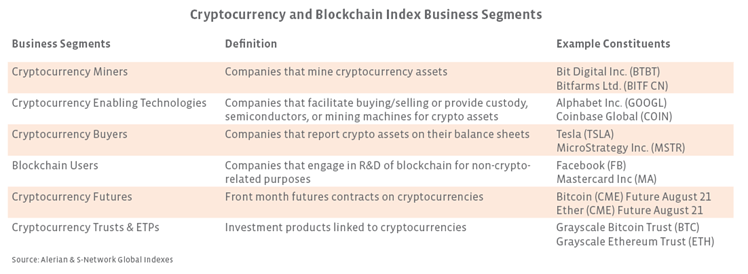
It is important to differentiate cryptocurrency trading (i.e. buying and selling Bitcoin, Ethereum, etc. directly) from investing in cryptocurrency/blockchain as an asset class. Investors looking to access the cryptocurrency’s growth as an asset class — rather than trading on short-term news — may prefer investing through an index-linked product. The Alerian Galaxy Global Blockchain and Crypto Index family offers various methods of investing in the asset class, including equities (which includes cryptocurrency miners, enablers, buyers and blockchain users), cryptocurrency futures, as well as cryptocurrency trusts and exchange-traded products.
Both index suites offer a pure-play opportunity, with 80% of the weighting coming from companies that have over 50% of their business in crypto activities. The remaining 20% tranche consists of diversified companies. The equity portions of both tranches are equally weighted, representing a truly diversified portfolio of the crypto ecosystem. Additionally, the indices reflect the global reach of the crypto/blockchain market, with BLKCHN and CRYPTE (the equity-only indices) made up of only 61% and 37% domestic equities, respectively.

bottom line
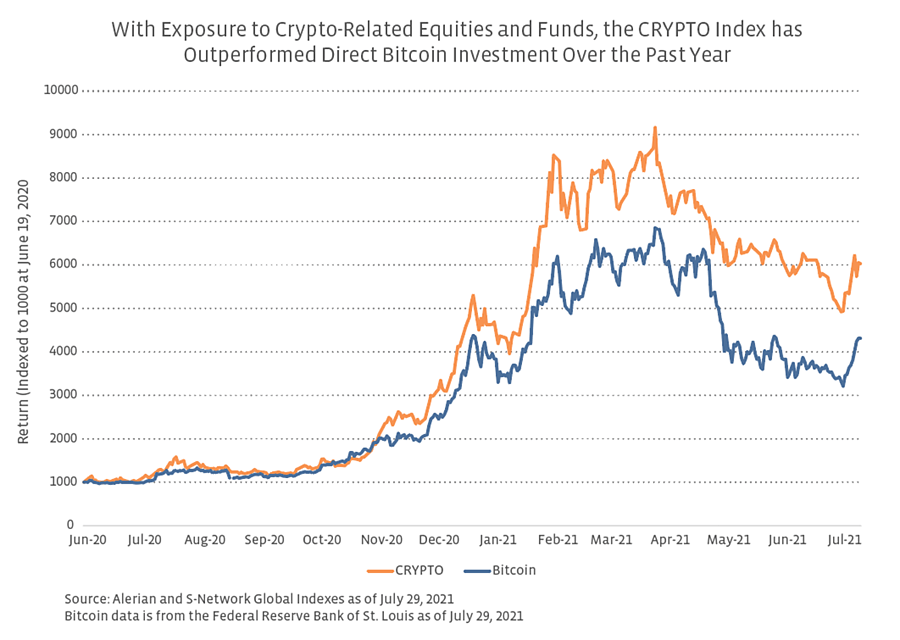
Cryptocurrencies like Bitcoin and Ethereum have become household names, particularly with daily media coverage and large corporations incorporating both crypto and blockchain into their operations. Rather than trading on technical analysis and short-term news, investors may prefer the option of investing in the long-term trend behind crypto and blockchain — with key themes such as digitization, decentralized finance, and investor participation.
Disclosure: © Alerian 2021. All rights reserved. This material is reproduced with the prior permission of Alerian. They are for general information only and should not be construed as investment advice. Alerian employees are prohibited from owning individual MLPs. For more information on Alerian and our full disclaimer, visit Disclaimer | Alerian
Original post
Learn Crypto Trading, Yield Farms, Income strategies and more at CrytoAnswers
https://nov.link/cryptoanswers
Comments are closed.